
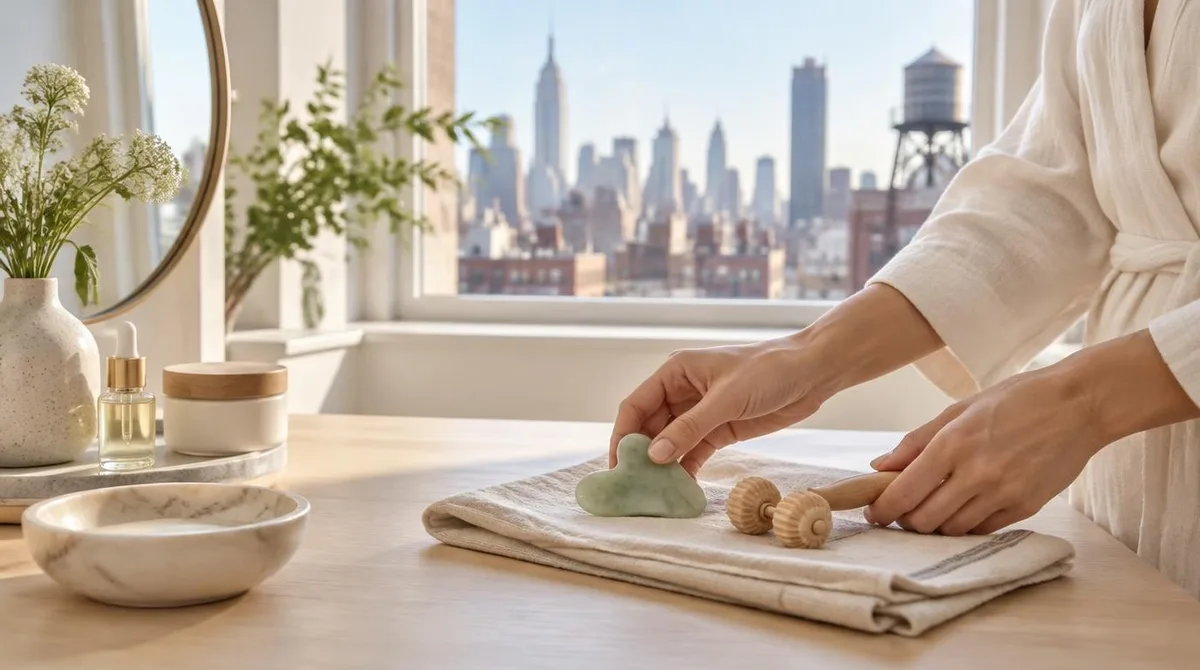
A trade publication just made the case that the smartest gift this season has no battery. American Salon's roundup, published November 12, 2026, collects 12 low-tech beauty and wellness gifts chosen precisely because they need no apps, no charging cables, and no subscription fees, according to American Salon. The framing is the story: in a market saturated with smart mirrors and connected devices, a beauty-industry outlet is betting readers want tactile, hands-on tools instead.
Why does a gift list matter? Because gift guides are a readable index of what the wellness economy thinks will sell. When the categories cluster the way these do, around massage, drainage, and recovery, that tells you something about the season's mood, not just one editor's taste. It also tells you the industry has noticed a fatigue with gadgets that require Wi-Fi, a password, and a monthly plan to do their work.
There is a familiar rhythm here, too. A ritual, done by hand, at the end of a long day. No notifications. The appeal is partly practical and partly emotional, and the list leans into both.
What's actually on the list?
Most of the 12 items fall into three loose groups. The first is massage and manual manipulation: the Repêchage Kansa wand, a bronze-alloy head on a wooden handle rooted in Ayurvedic tradition, which the brand says helps stimulate the skin's surface and support lymphatic drainage; Mount Lai's gua sha gemstone tools in obsidian, white jade, rose quartz, and amethyst, grounded in traditional Chinese medicine techniques; Cecily Braden's limited-edition tortoiseshell lymphatic brush with patented bristles designed to move excess tissue fluid; and Pranamat's three-piece acupressure set, covered in lotus-shaped massage elements intended to stimulate pressure points.
The second group is recovery. Valsole recovery slides pair cushioning with arch support and a deep heel cradle, aimed at plantar fasciitis relief and hours on hard floors. Redwood Outdoors offers an Alaskan cold plunge tub made of heat-treated Canadian hemlock that holds up to 130 gallons and, notably, requires no electricity, just water and ice. Dream Recovery's weighted blanket adds a twist: 25 pounds of deep-pressure comfort layered with what the brand calls infrared textile technology, mineral-infused fibers said to convert body heat into infrared energy, wrapped in breathable organic cotton.
The third group is small, quiet tools of habit. Uncommon Goods sells a mindful breathing necklace inspired, per the listing, by Japan's Komusō monks, a tubular pendant that slows the exhale. High Peak prints reflexology maps on socks and gloves so beginners can find pressure points without guessing. Olivia Garden's Scalp Diva collection splits scalp care into three brushes: one for massage, one for cleansing, one for deeper exfoliation. Esker Beauty's lymphatic drainage dots are wearable patches targeting six drainage points, infused with magnesium, green tea, ginger, buckeye seed, and vitamin B12. And Voesh's vitamin C shower filter, with colloidal oatmeal, hyaluronic acid, botanical oils, and vegan probiotics, brings what the brand calls hydrotherapy into the shower while helping neutralize chlorine.
Why is low-tech having a moment?
Read the list as a whole and a pattern emerges. Not one item needs a firmware update. That is a deliberate editorial stance from a publication that covers salon technology for a living. It suggests the trade side of the industry sees appetite for tools that do one thing, work without setup, and never ask for a subscription renewal.
It also tracks with broader wellness currents the list itself names: hydrotherapy, cryotherapy and contrast therapy, lymphatic drainage, breathwork. These are practices with long histories, repackaged for home use. The gift-guide format makes them accessible entry points. A gua sha stone costs less than a connected skin analyzer and never needs pairing with a phone.
There is a commercial logic as well. Subscription fatigue is real in beauty, where devices increasingly bundle apps and paid content. A gift that is a one-time purchase sidesteps that whole conversation. For gift-givers, that simplicity is the selling point; for brands, it removes a barrier at the exact moment of purchase. We covered a connected angle in California's Packaging Law Went Live May 1: What It Asks of Beauty Brands.
What should a careful reader notice?
Most of the claims here are brand claims. The Kansa wand's lymphatic support, the blanket's infrared circulation benefits, the patches' fluid movement, these are descriptions from the manufacturers and the roundup, not independent trial results. That is normal for gift coverage, but it matters for expectations. A tool may feel wonderful and still have thin published evidence behind its specific physiological promises. Treat the sensory experience as the reliable part and the mechanistic claims as the brands' own framing.
Two items deserve a closer look on the label, too. The shower filter's ingredient story, vitamin C plus oatmeal and probiotics, sits alongside its actual function of neutralizing chlorine, and the Esker patches list supplement-adjacent ingredients such as magnesium and vitamin B12 in a topical format. Neither makes the product useless; both mean the label is doing more than one job at once. Readers who want the ingredient-literacy angle will find our hyaluronic acid explainer useful context for filter formulations like Voesh's.
What does this mean for the shelf?
For anyone shopping, the practical takeaway is to buy the ritual, not the promise. A scalp brush, a breathing pendant, or an acupressure mat succeeds if it becomes a habit you keep. The list's own logic supports that: these are tools for slowing down, and their value compounds with use, not with specs.
For the industry, the roundup hints at where gifting is headed: recovery, manual tools, and screen-free rituals, with an undercurrent of skepticism toward connected devices. Whether that is a lasting shift or a seasonal swing is not something the evidence settles. What it does show is that a major trade outlet judged unplugged products newsworthy in November 2026, and put them at the center of its gift coverage. For more on how the beauty business reads its own numbers, see our coverage of Ulta's blockbuster quarter, and for the wider context, our beauty news hub tracks these currents as they develop. The wellness side of this story, from cold plunges to breathwork, lives in our wellness coverage. For related coverage, see Ulta's Blockbuster Quarter: What Q4 Numbers Say About Beauty Demand.