
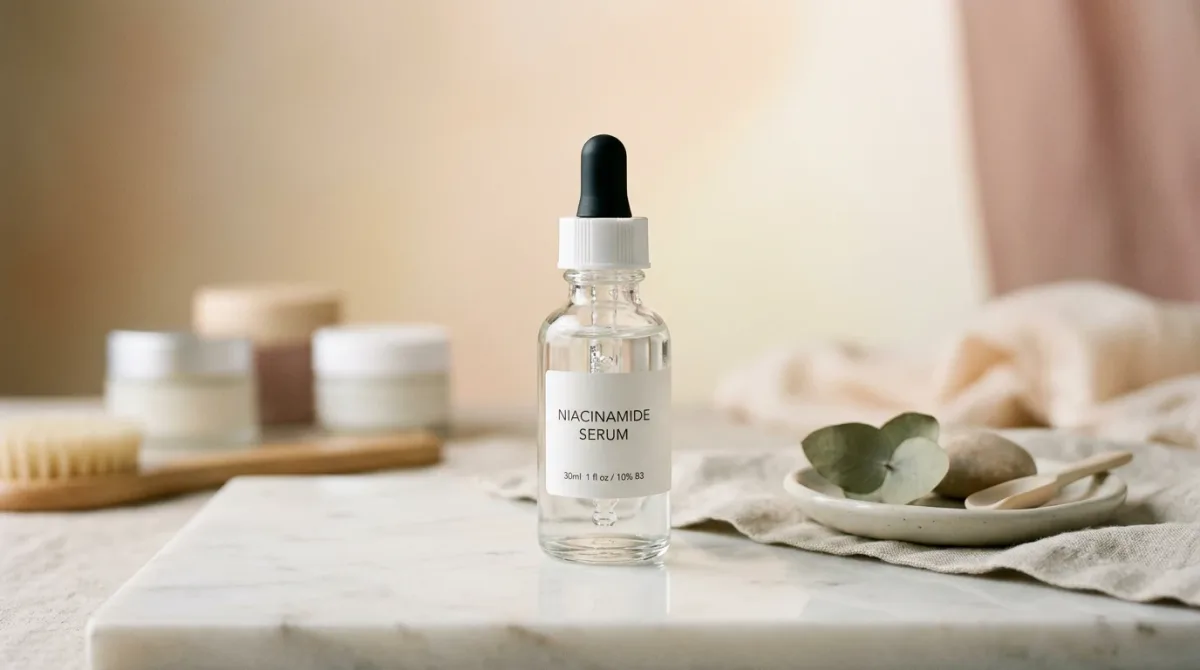
Niacinamide, a water-soluble form of vitamin B3 formulated into moisturizers and serums at concentrations typically between 2% and 5%, has been shown in randomized, vehicle-controlled trials to modestly reduce the visible area and evenness of facial hyperpigmentation over eight to ten weeks of daily use — a measurable shift in pigment distribution, not spot removal, and one that shows up alongside sunscreen, not instead of it.
This is information, not medical advice. Persistent dark spots, melasma, and other pigmentation changes can have causes that range from sun exposure to hormonal shifts to underlying skin conditions, and sorting that out belongs with a dermatologist rather than an ingredient list.
What is niacinamide, chemically?
Niacinamide is the amide form of niacin (vitamin B3), prized in formulation for being stable at a wider pH range than some of its ingredient neighbors and for layering easily with retinoids, vitamin C, and exfoliating acids. It shows up on ingredient panels as niacinamide or nicotinamide — the same molecule, different naming convention. Its cosmetic-chemistry reputation rests on multiple, separate mechanisms: it is studied as a modulator of melanosome transfer (the process by which pigment moves from melanocytes into surrounding skin cells), as a support for the skin's barrier lipids, and as a regulator of sebum output. Those are three distinct claims with three distinct evidence bases, and the strength of the data is not the same across all of them.
Does niacinamide actually fade dark spots?
The best-known evidence here is a 2010 trial in the British Journal of Dermatology, led by dermatologist A.B. Kimball, which tested a moisturizer combining 4% niacinamide with 2% N-acetyl glucosamine against a vehicle-only control in 202 women ages 40 to 60 with facial hyperpigmentation, over a 10-week period following a 2-week washout. The combination formulation was significantly more effective than the vehicle control at reducing the detectable area of facial spots and improving pigment evenness, measured by computer image analysis, expert visual grading, and chromameter readings — with the authors reporting an effect beyond what SPF 15 sunscreen use alone produced in the control arm. It is worth being precise about what was tested: a combination formulation, not niacinamide in isolation, evaluated against a moisturizer base rather than against no treatment at all.
A second, independent trial published in 2014 in Skin Research and Technology pointed the same direction. Researchers led by Do Hyun Lee ran a randomized, double-blind, vehicle-controlled study in 42 Korean women ages 30 to 60, applying a formulation combining 2% niacinamide with 2% tranexamic acid twice daily for eight weeks, with sunscreen assigned to both arms each morning. The active formulation again outperformed vehicle control on mexameter and chromameter readings and physician photographic assessment, reducing the appearance of irregular pigmentation beyond what sunscreen alone achieved — though, as in the 2010 study, the tested product paired niacinamide with a second active ingredient rather than isolating it.
| Trial | Formulation tested | Participants | Duration | Comparator | Reported outcome |
|---|---|---|---|---|---|
| Kimball et al., 2010, Br J Dermatol | 4% niacinamide + 2% N-acetyl glucosamine moisturizer | 202 women, ages 40–60 | 10 weeks | Vehicle-only moisturizer | Reduced facial spot area and improved pigment evenness vs. control |
| Lee et al., 2014, Skin Res Technol | 2% niacinamide + 2% tranexamic acid | 42 women, ages 30–60 | 8 weeks | Vehicle control, both arms sunscreen-assigned | Reduced pigmentation vs. control on objective and photographic measures |
Taken together, the two trials are consistent rather than identical: both are vehicle-controlled, both run eight to ten weeks, both use objective measurement alongside expert grading, and both land on a modest, statistically significant improvement in pigment evenness — not a claim of clearance, and not a test of niacinamide as a stand-alone ingredient at drugstore concentrations used without a partner active.
What about oil production and the skin barrier?
Niacinamide's reputation as an oil-regulating ingredient traces to smaller, older sebum-focused research from the mid-2000s examining topical niacinamide's effect on facial sebum excretion rate in Japanese and Caucasian subjects; that body of work is frequently cited in consumer coverage, including a summary on Healthline's niacinamide overview, which notes that most commercial formulations sit at 5% or below and that niacinamide is also studied for skin-barrier support and inflammation associated with conditions such as psoriasis and atopic dermatitis — while cautioning, accurately, that more research is needed to settle the size of those effects. The barrier and sebum claims are directionally supported but rest on a thinner, older evidence base than the pigmentation trials above, and the site's own review is explicit that this thinness is a real limitation, not an omission.
What the evidence does not show
Neither trial isolated niacinamide as a single active ingredient against a true no-treatment control; both tested it in combination with a second compound (N-acetyl glucosamine or tranexamic acid) inside a specific moisturizer base, which means the pigment improvement documented belongs to those formulations, not to niacinamide as a category claim applicable to any product carrying the name on its label. Nor do these trials speak to melasma specifically, to non-facial skin, to concentrations above 4%, or to niacinamide layered with retinoids or acids, all common in-market practices that have not been tested this way. Anyone using “brightening” language about niacinamide products is making a cosmetic claim about appearance, not a drug claim about treating a diagnosed skin condition, and the two should not be read as interchangeable.
Where this leaves a reader's regimen
The clinical case for niacinamide's role in evening pigmentation is real but bounded: two independent, vehicle-controlled trials, run a continent apart, on formulations that paired it with a second ingredient, over eight-to-ten-week windows, with sunscreen as a constant. In a city where a dermatologist's booking calendar can run as tight as a restaurant reservation list, that specificity is worth carrying into any conversation with a clinician about a personal pigmentation concern — along with the reminder that spots with an unclear cause, or ones that change shape or color, are a reason to see a dermatologist rather than to adjust a shelf.
For a related wellness perspective, read What is the talk show Ari Global on Gossip Stone all about?.