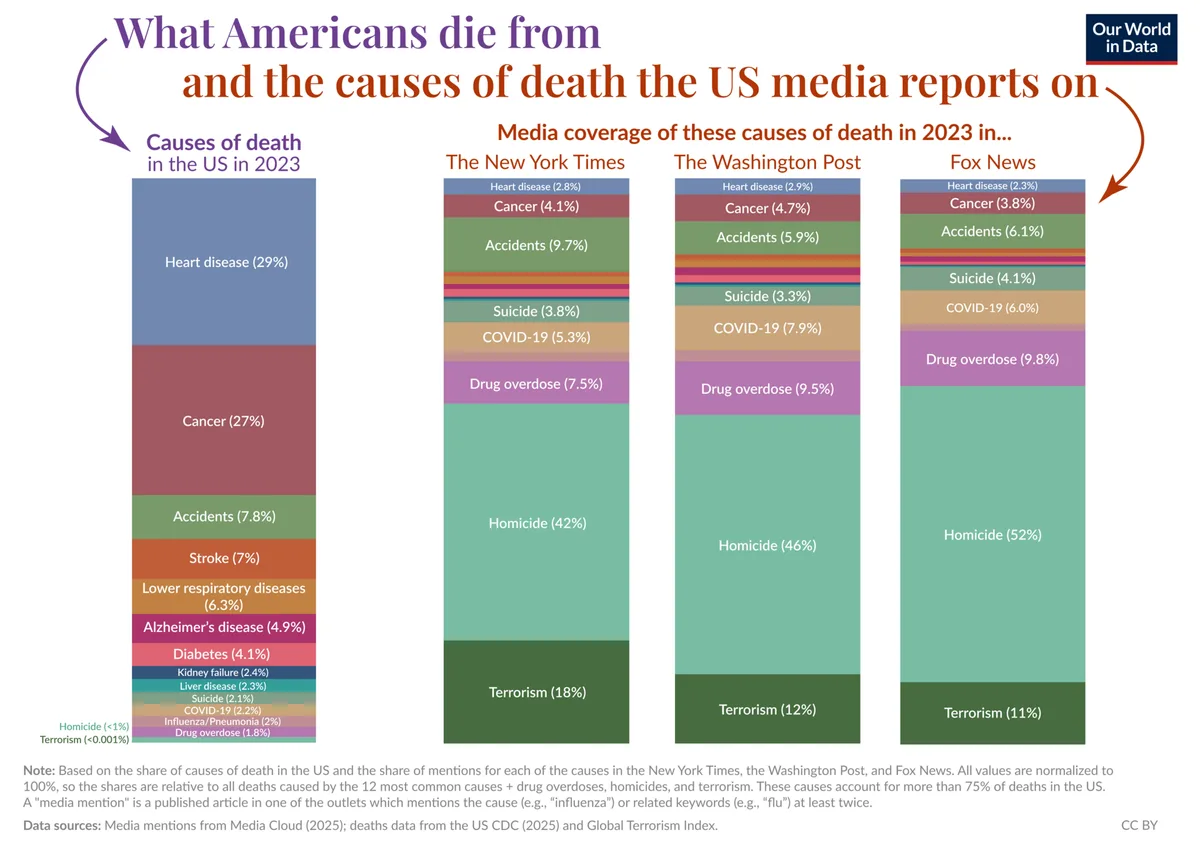

A headline that says a common food "may raise your risk" of something is usually reporting a single study, in a specific group of people, with a result that may not hold up. The gap between what a study found and what a headline implies is where most of the panic lives. Learning to close that gap takes about five minutes and a short list of questions.
It will not tell you what a study means for your body, because no headline can do that. It will tell you how to figure out what a health news story actually established, what it skipped, and when the honest answer is "we don't know yet."
Why do health headlines overstate the science?
Because a headline competes for a click, and "study finds modest association in mice" competes badly. The pressure runs in one direction: toward stronger verbs, bigger numbers, and shorter chains of qualification. The study itself usually sits several qualifications below the headline, and the qualifications are where the truth is stored.
The mismatch is structural, not a conspiracy. A press office writes a summary, a reporter reads the summary or the abstract, an editor writes the headline, and each step trims nuance. By the time a story reaches your feed, the careful middle has often been cut entirely. Knowing this, you can read a headline as an advertisement for a paper rather than a description of it.
What should you check first in any health news article?
Check what kind of study it was. The hierarchy matters more than the finding. A randomized controlled trial, where people are assigned by chance to one intervention or another, carries far more weight than an observational study, which can only show that two things moved together. Animal and lab-dish studies are earlier still, and their results frequently fail to repeat in humans.
Then check the size of the effect. A study can be statistically significant and clinically trivial at the same time. "Statistically significant" means the result is unlikely to be pure chance; it says nothing about whether the change matters in a life. A headline built on a small percentage shift in a surrogate marker deserves more caution than the adjectives suggest.
- Who was studied? Mice, young men, or people with an existing condition all limit what the finding can say about you.
- How long did it run? A six-week result says little about a decade of habits.
- Who paid? Funding does not invalidate a study, but it belongs in the first paragraph, not the last.
- What was measured? A blood marker is not a disease outcome. Substitute endpoints are where overstatement breeds.
How does the word "health" itself get stretched?
Part of the confusion is that health is not one thing, and stories rarely say which version they mean. As Medical News Today explains in its overview of the term, health refers to complete emotional, mental, and physical well-being, and the World Health Organization's 1948 definition framed it as "a state of complete physical, mental, and social well-being and not merely the absence of disease or infirmity." A story about a cholesterol marker and a story about resilience are both "health" stories, and they are not equally easy to measure.
The same overview notes that a 2021 commentary described health as multi-dimensional, dynamic, and continuous, shaped by adaptation and balance rather than by a single number. That matters for reading the news: any article that reduces health to one metric, one food, or one habit is flattening something the definitional literature treats as genuinely layered.
Context also gets dropped. As Wikipedia's health entry summarizes, health is affected by individual choices and by structural determinants, including how society is arranged so that some people find it easier than others to receive care or act on health advice. A study conducted in one population, one income bracket, or one healthcare system may not travel well, and the determinant context is often the first thing a headline leaves behind.
What does "association" mean, and why does it matter?
Association means two things moved together in the same data set. It does not mean one caused the other. People who take a supplement may also exercise more, earn more, and see doctors more often; the supplement may be a marker of a whole lifestyle rather than the active ingredient. Researchers call this confounding, and it is the single most common reason an observational headline collapses on a second read.
A useful habit is to rewrite the headline in plain terms. "Coffee linked to lower dementia risk" becomes "in this study, coffee drinkers also had lower dementia rates, for reasons the study could not separate." If the rewritten sentence feels unremarkable, the original headline was doing the work of the finding. This connects to our earlier piece, WHO: Up to 45% of Dementia Risk Is Preventable.
What this means for how you read our coverage
Our analysis, applied to our own beat: the stories that survive scrutiny are the ones that name their limits in the first three paragraphs. When we covered WHO's finding that up to 45% of dementia risk is preventable, the useful part was not the number but the list of modifiable factors behind it. When we reported CDC flu data from a severe season, the value was in the surveillance numbers, not in any single takeaway. Data with a named collector and a stated method is the standard every health story should meet. Readers following this should also see CDC Flu Data: A Severe Season, by the Numbers.
Practical steps, the next time a headline stops your scroll:
- Open the story and find the study. If the article never names or links the research, treat the claim as unverified.
- Identify the study type in one phrase: trial, observational, animal, or lab.
- Look for the effect size, not just the direction. "Linked to" plus no number is a flag.
- Check who funded it and whether the article says so.
- Ask whether the population studied resembles anyone you know. If not, the finding is a lead for researchers, not a to-do for you.
None of this makes you a cynic. It makes you the reader the study authors actually wrote for. Most researchers would rather be quoted with their caveats intact than without them, and the caveats are where the honest story lives.
When should a health story change what you do?
Rarely on day one, and never on a single observational result. The findings worth acting on tend to be confirmed across multiple studies, in different populations, over years. Until then, a new result is a data point in an ongoing argument, not an instruction. Decisions about screening, medication, or treatment belong with a clinician who knows your history, not with a headline.
There is also a scale problem worth remembering. According to the CDC figures cited by Medical News Today, United States healthcare costs reached $3.8 trillion in 2019, and despite that spending, life expectancy in the United States trails other developed countries. The biggest movers of population health, from where someone lives to income and education, are exactly the factors a single-study headline never touches. Individual news is worth reading carefully. Structural news is worth reading at all.
The takeaway: read the study, not the adjectives. Health journalism does its job when it survives your five minutes of questions, and the best stories, including the ones on this site, are written to survive them.