
For most healthy adults, the evidence still supports a modest dose: 600 IU of vitamin D daily, rising to 800 IU after age 70, per the National Academies' Dietary Reference Intakes from 2011, with a tolerable upper limit of 4,000 IU. What changed is the case for taking more or for measuring: the Endocrine Society's 2024 clinical practice guideline advised against routine 25-hydroxyvitamin D testing in healthy adults and against empiric high-dose supplementation, and the 25,871-participant VITAL trial in the New England Journal of Medicine in 2018 found 2,000 IU daily did not significantly reduce cancer or cardiovascular events in a generally replete population.
Vitamin D decisions hinge on individual risk factors, medications, and blood levels, so diagnosis and treatment belong with a clinician.
How much vitamin D do the official bodies actually recommend?
The numbers have been stable since 2011 and are worth stating precisely. The National Academies set the Recommended Dietary Allowance at 600 IU per day for adults aged 1 through 70 and 800 IU for those over 70, an intake estimated to meet the needs of 97 to 98 percent of healthy people. The tolerable upper intake level is 4,000 IU daily for adults — the point above which the risk of hypercalcemia begins to rise in the institute's risk assessment. The NIH Office of Dietary Supplements fact sheet also lists an Estimated Average Requirement of 400 IU, a reminder that the RDA is deliberately conservative.
| Group | RDA (per day) | Upper limit (per day) |
|---|---|---|
| Adults 19–70 | 600 IU | 4,000 IU |
| Adults over 70 | 800 IU | 4,000 IU |
| Pregnancy and lactation | 600 IU | 4,000 IU |
Sources: Dietary Reference Intakes for Calcium and Vitamin D, National Academies, 2011; NIH Office of Dietary Supplements vitamin D fact sheet. Neither figure is a site recommendation — the tables summarize the published reference values.
Did the VITAL trial change the dosing picture?
It changed the expectations, not the RDA. VITAL, reported by Manson and colleagues in the New England Journal of Medicine in 2018, randomized 25,871 American adults to 2,000 IU of vitamin D3 daily or placebo for a median of 5.3 years. Invasive cancer and major cardiovascular events were not significantly lower in the supplement arm, though secondary analyses suggested a possible signal for cancer mortality that the authors framed as hypothesis-generating. The interpretation that matters for dosing: a generally vitamin-replete population at a dose ten times the RDA showed no broad disease prevention, which weakened the argument for the multi-thousand-IU regimens that dominated the supplement aisle.
What about fractures and falls?
The same pattern. The US Preventive Services Task Force concluded in 2021 that current evidence is insufficient to assess supplementation for fall or fracture prevention in community-dwelling adults who are not deficient, and it recommended against doses of 400 IU or less for fracture prevention after trials such as the 2018 Lancet Diabetes and Endocrinology pooled analysis by Bolland and colleagues found no fracture benefit at lower doses. The notable exception in the trial record is the STURDY study population of older adults with elevated fall risk, where dose-finding work pointed to 1,000 IU as a level worth testing rather than a proven regimen.
Should I know my blood level, and what counts as deficient?
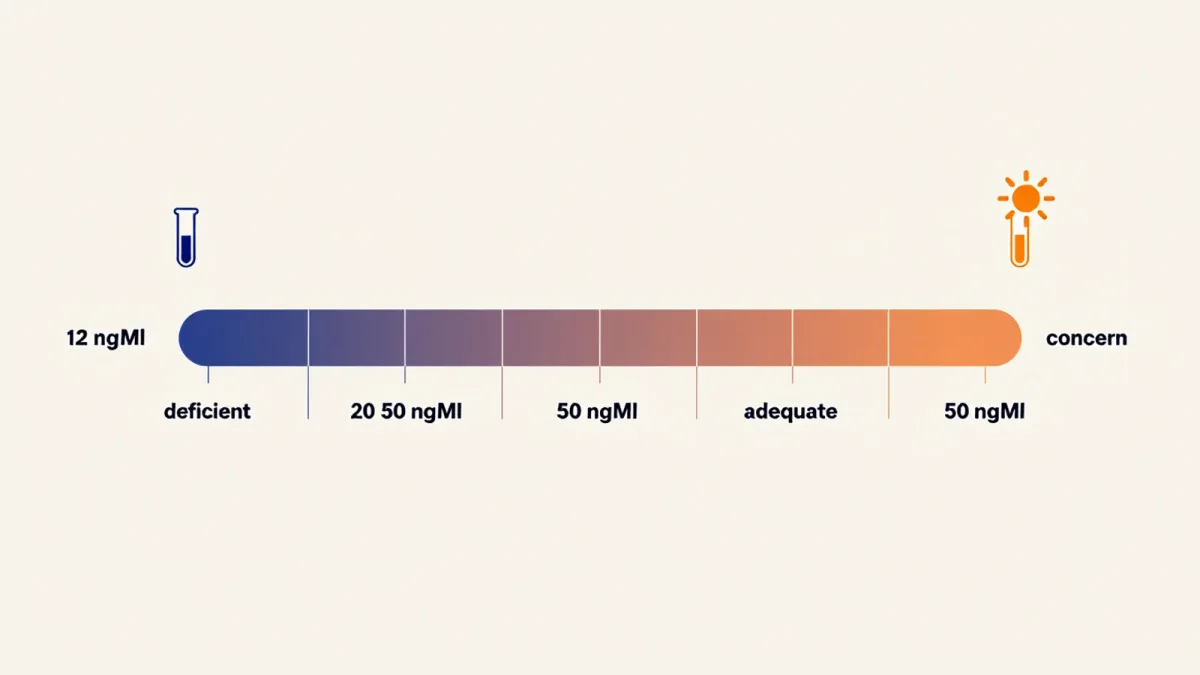
The Endocrine Society's 2024 guideline, published in the Journal of Clinical Endocrinology and Metabolism, said no routine testing for healthy adults under 75 — screening failed to identify groups in whom treatment changed outcomes. The thresholds themselves come from the National Academies: below 12 ng/mL of 25-hydroxyvitamin D is the level associated with deficiency and bone risk, 20 ng/mL and above meets the requirement for most people, and values above 50 ng/mL raise the concern for excess. Laboratories often report 30 ng/mL as a cutoff, which traces to professional-society guidance rather than the institute's analysis — one reason blood test interpretations vary so widely between offices.
D2 or D3 — does the form change the dose?
D3, cholecalciferol, is the more potent and longer-lasting form in most head-to-head work. A 2012 randomized trial by Tripkovic and colleagues in the American Journal of Clinical Nutrition found D3 raised serum 25-hydroxyvitamin D more effectively than D2, and a 2020 meta-analysis in the same journal reached a similar conclusion. The practical difference is modest at standard intakes but widens at high doses; a clinician managing an actual deficiency will typically use D3, though D2 remains a legitimate prescription option.
Who genuinely needs more than 600 IU?
The 2024 Endocrine Society guideline kept empiric supplementation for several groups: infants, children and adolescents, pregnant adults, adults over 75, and people with prediabetes, where the trial evidence pointed toward benefit. Absorption problems — celiac disease, bariatric surgery, inflammatory bowel disease — and certain medications, including some anticonvulsants, also change the calculus. Those decisions are individual and belong with a clinician; the guideline's point is precisely that they should not be generalized to everyone standing in a supplement aisle.
The decade's lesson, in one sentence: the trials tested doses far above the RDA and mostly came back neutral, so the number on the bottle has grown less important than whether you are actually deficient.
Frequently asked questions
Is 600 IU really enough if I live somewhere with winters?
For preventing deficiency in most adults, yes — the RDA was set from bone-health data, not sunshine exposure, and skin synthesis varies enormously by latitude, season, and skin tone. People with limited sun exposure can discuss testing with a clinician, though the 2024 guideline discourages routine screening in healthy adults under 75.
Can I take 5,000 IU a day because the bottle sells it?
That exceeds the 4,000 IU tolerable upper limit set by the National Academies. Sustained intakes above the limit raise the risk of hypercalcemia over time. High-dose regimens are used clinically under supervision for confirmed deficiency, which is a different situation from self-directed daily use.
What happened to vitamin D and COVID-19 claims?
As of early 2026, randomized evidence for supplementation preventing or treating COVID-19 remained limited and mixed, and major bodies including the NIH did not recommend vitamin D for that purpose. Observational links between low levels and worse outcomes were not matched by clear trial benefits.
Should I take vitamin D with fat?
Yes. Vitamin D is fat-soluble, and small crossover studies have shown greater absorption when taken with a meal containing fat. The effect is real but does not change the total daily requirement.