
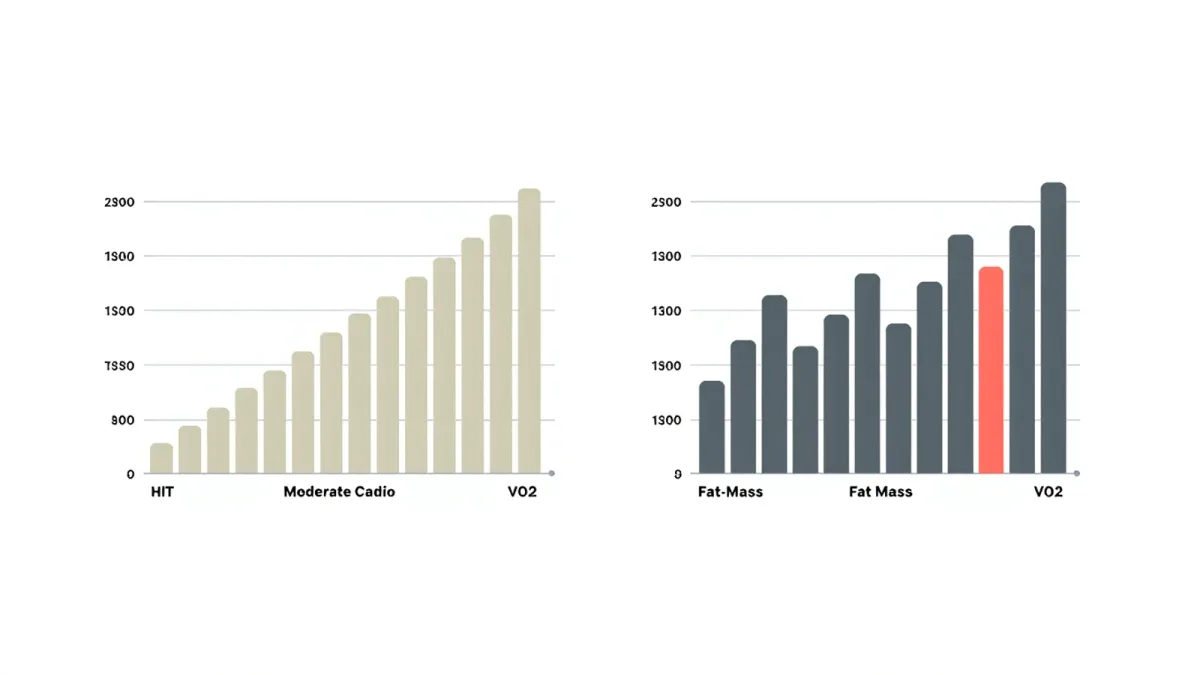
Short answer: HIIT is a time machine, not a fat-burn switch. A 2015 meta-analysis in the Journal of the American Heart Association by Milanović and colleagues found interval training improved cardiorespiratory fitness nearly twice as much as continuous moderate training, yet reviews of body-composition outcomes — including a 2017 systematic review in Obesity Reviews of overweight adults — found the two methods produced similarly modest fat-mass losses when programs lasted the same weeks.
Interval work stresses the cardiovascular system hard enough that anyone with heart disease, uncontrolled blood pressure, or a long sedentary stretch should clear the plan with a clinician before the first sprint.
Why doesn't the higher intensity melt more fat?
Because fat loss is governed by energy balance, not by how a workout feels. Interval sessions do burn calories at a ferocious per-minute rate, but the sessions are short; a 20-minute interval workout with warm-up and cool-down may spend a similar total energy to a longer, gentler one. Some research has explored excess post-exercise oxygen consumption — the metabolic afterglow — and found it real but small, measured in tens of calories rather than hundreds.
That arithmetic is why head-to-head trials keep arriving at the same unglamorous conclusion: match the programs for total energy expenditure and training duration, and fat loss lands in the same neighborhood. The 2017 review of interval versus continuous training in overweight and obese adults reported small average reductions in fat mass for both, with no meaningful champion.
Where HIIT genuinely wins
Fitness, not fat, is where the intervals earn their reputation. The Milanović meta-analysis pooled 27 trials and found VO2max — the usual proxy for cardiorespiratory fitness — rose markedly more with high-intensity intervals than with continuous training of equal weekly frequency. Fitness, in turn, tracks with long-term health outcomes in cohort research, so the advantage is not cosmetic.
Time is the other honest win. Public health guidance calls for 150 minutes of moderate aerobic activity weekly; comparable benefit appears reachable in roughly half to two-thirds of that with vigorous intervals, per the Physical Activity Guidelines' intensity equivalencies. For anyone whose excuse is the clock, that compression is the product.
| Factor | HIIT | Moderate continuous |
|---|---|---|
| Cardiorespiratory fitness gains | Larger per session (JAHA meta-analysis, 2015) | Smaller, builds gradually |
| Fat loss over 12+ weeks | Small and similar to moderate training | Small and similar to intervals |
| Weekly time needed | ~75–90 minutes, vigorous | ~150 minutes, moderate |
| Muscle and joint stress | High; sprinting is demanding | Lower; easier to repeat |
| Beginner friendliness | Poor — skill and base fitness help | Good |
Does one hurt recovery more than the other?
Yes, and this is where program design quietly decides results. Hard interval days impose a recovery debt — central fatigue, muscle damage, appetite turbulence — that moderate sessions mostly do not. Trainers who program intervals daily tend to collect diminishing returns and nagging injuries, particularly with sprinting or jumping variations. The sustainable pattern most coaches converge on is one to three interval sessions weekly, with moderate work filling the gaps rather than disappearing from the calendar.
The format of cardio is a preference; the size of the calorie gap is the mechanism. Programs that confuse the two tend to blame the intervals.
Does hard cardio make you hungrier?
Appetite is the quiet variable the fat-burn debates skip. Exercise science has explored how intensity changes hunger hormones and subsequent eating, with findings that resist a tidy slogan: vigorous exercise can temporarily blunt appetite for some people, while others compensate at the next meal without noticing. What seems consistent is that compensation, when it happens, is easier to spot after a structured plan than after a casual gym visit. Anyone using cardio for fat loss is better served by watching the weekly scale of intake — loosely, not obsessively — than by assuming a hard session purchased a pastry.
Which one do people actually stick with?
Adherence research offers a split verdict that surprises both camps. In supervised trials, drop-out and enjoyment differences between formats are usually small; in unsupervised real life, the all-out reputation of HIIT intimidates beginners, while the hour-long monotony of steady state bores others. The 2017 body-composition review noted wide variation in program designs, a hint that the format matters less than whether the participant finishes the twelve weeks.
A calm way to choose: pick the version you will still be doing in March. Fat loss rewards a deficit held for months, and either format can ride alongside it.
How should the two be combined?
- Two moderate sessions of 30–45 minutes — brisk walking, cycling, easy rowing — as the weekly base.
- One to two interval sessions, for example 6–8 rounds of 30 seconds hard and 90 seconds easy after a full warm-up.
- One full rest day, at minimum, between interval days.
- A calorie deficit carried by the kitchen, sized modestly, if fat loss is the goal; the cardio protects fitness and health while the deficit does the subtracting.
The vanity of the debate — intervals versus steady state — dissolves once the goal is named. For fat loss, the deficit decides; for fitness per minute, intervals win; for sheer survivability of a routine, moderate work quietly carries most people across the finish line.