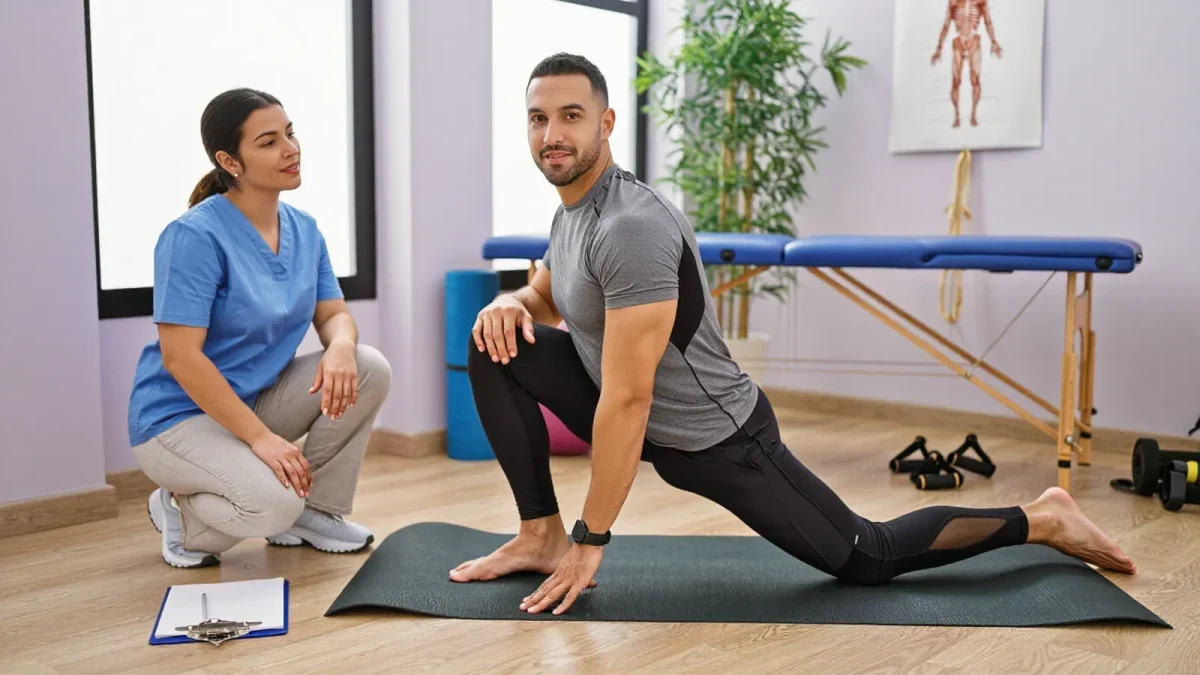
Mobility training reliably improves range of motion — that much the evidence supports clearly — but its bolder promises deserve more caution. Foam rolling acutely increases flexibility without hurting performance, per a 2015 systematic review by Cheatham and colleagues in the Journal of Bodywork and Movement Therapies, while long-term flexibility gains come mainly from regular stretching. What the data do less well is prove the headline claims: injury prevention and performance enhancement, where findings remain mixed and often smaller than advertised.
Restricted range from injury, surgery or neurological conditions belongs with a physical therapist; generic mobility routines are for healthy joints that simply want to move farther.
What is the difference between mobility and flexibility?
Flexibility is passive: how far a joint travels when something else — gravity, a strap, a therapist — provides the force. Mobility is active: how far you can move the joint under your own control. The distinction is mostly a modern packaging of old ingredients — stretching, strengthening at end range, and motor control — and it matters because passive range alone has never guaranteed much. A gymnast who can be stretched into a split but cannot hold one owns less usable range than the split suggests.
Programming that respects the distinction pairs end-range holds with strength at those positions: deep squats, controlled articular rotations, loaded stretching. None of it is new; some of it is newly branded.
Does stretching before a workout help or hurt?
Depends on the stretching and the ask. Long static holds immediately before explosive effort can slightly reduce strength and power, a finding replicated across reviews including work summarized by Behm and Chaouachi in 2011 — though the reductions are smaller than once feared, and disappear with short holds or a dynamic warm-up. Dynamic warm-ups, by contrast, reliably prepare tissue for the session ahead. The practical order most evidence favors: dynamic movements first, static stretching after training or in separate sessions.
| Method | Range of motion | Performance effect | Evidence strength |
|---|---|---|---|
| Static stretching, regular weeks | Clear long-term gains | Neutral when not pre-exercise | Strong |
| Static stretching, pre-workout | Acute gains | Slight power reduction possible | Moderate |
| Dynamic warm-up | Acute gains | Neutral to positive | Strong |
| Foam rolling | Acute gains without strength loss (Cheatham et al., 2015) | Neutral; soreness relief reported | Moderate |
Does mobility work prevent injuries?
This is where the marketing outruns the data. The most cited analysis in the field — a 2014 meta-analysis by Lauersen and colleagues in the British Journal of Sports Medicine pooling dozens of trials — found strength training reduced sports injuries substantially, while stretching showed no significant protective effect on its own. Foam-rolling and mobility-flow studies rarely measure injuries at all; they measure immediate range, which is a different endpoint.
A defensible middle position: mobility work supports the training that protects you. Full-range strength training — deep squats, controlled Romanian deadlifts, overhead work — delivers both tissue capacity and the strength stimulus with the documented injury record. Floor routines are the accessory, not the armor.
Why do desk workers feel so stiff?
Prolonged sitting shortens the positions your hips and spine occupy for hours, and the nervous system adapts by defending its most familiar ranges. Regular movement breaks — standing, hip flexor extensions, thoracic rotations — address the habit, not just the tissue. The stiffness itself is rarely structural damage; most desk-bound limits are express trains of disuse that respond to consistent loading within weeks.
Does more range of motion improve performance?
Sport by sport, the answer changes shape. Sprinting, throwing and deep-weightlifting positions use large ranges under load, so usable range there has a plausible performance case; long-distance running, by contrast, spends its arc mid-range, which is why stretching studies in distance runners so often show nothing for times or economy. Reviews of long-term stretching programs — weeks of regular work rather than a pre-exercise fidget — have reported small improvements in strength and jump measures, a counterintuitive finding that suggests flexibility training is less inert than the acute studies implied. The scale, however, is small: minutes earned, not medals.
Does yoga count as mobility training?
Largely yes, with a nuance. Yoga's held positions deliver the sustained stretching that changes range, and its strength demands — holding a deep lunge, controlling a slow descent — build the end-range strength that passive stretching lacks. Trials of regular practice report flexibility gains consistent with the stretching literature. What yoga adds that most mobility routines omit is adherence: people return to practices they enjoy, and in adaptation research, showing up is half the dose. Anyone choosing between a branded mobility system and a style of yoga they will actually do, consistently, for months, should probably weigh the consistency first.
How much mobility work is enough?
- Five to ten minutes daily beats one heroic Sunday session; flexibility adapts to frequency.
- Hold static stretches 30 to 60 seconds for the tissues you want longer, after training or separately.
- Train strength at end range — deep but controlled positions — to convert passive range into usable range.
- Warm up dynamically before loading: leg swings, arm circles, gradual-depth squats.
The summary judgment lands where evidence usually does, somewhere less exciting than the ads and more useful than the cynics: mobility training does what it measurably does — moves joints farther, comfortably — and earns its ten minutes on those terms alone. The rest is marketing wearing a yoga mat.