The 30-minute anabolic window is, at most, a narrow sliver of the truth — and for most trainees, not a truth that changes outcomes. The definitive analysis came from Schoenfeld and Aragon's 2013 review in the Journal of the International Society of Sports Nutrition, which concluded that the anabolic window is a 'much wider period' than gym lore suggested, and that total daily protein intake is the overriding priority for muscle growth. Concerns about protein before or after exercise may be relevant only in the fasted state, where the body has been without amino acids for hours.
Kidney disease and conditions affected by protein intake deserve a clinician's guidance before diet changes of any size.
A stopwatch was never the mechanism: muscle growth runs on a daily amino-acid budget, and the budget, not the clock, is where gains are kept or lost.
Where did the anabolic window idea come from?
The kernel of science is real. After resistance exercise, muscles become more sensitive to amino acids, and early work documented elevated muscle protein synthesis for hours following training. Supplement companies compressed that physiology into a deadline: consume protein within 30 minutes or, on some labels, 15, and forfeit the growth. The compression, not the physiology, was the invention — early studies lacked controls for total protein, meaning timed groups and untimed groups often ate different daily amounts, and the timing difference was confounded from the start.
As is so often the case in nutrition, a sales deadline and a scientific finding share a name but not a definition.
What do controlled studies actually show?
The 2013 Schoenfeld and Aragon review assembled the picture: when total daily protein is matched, the apparent advantage of precise post-workout timing mostly evaporates. The pre- versus post-workout comparison they scrutinized — a trial by Hoffman and colleagues in trained men — found no meaningful difference in strength or hypertrophy whether the shake came before or after training. Subsequent analyses have reinforced the reading: the window, where one exists, extends perhaps four to six hours around the session, comfortably bridged by a normal meal schedule.
The narrow exception is fasted training. If you lift first thing in the morning without eating, some evidence supports feeding relatively soon afterward — the fasted condition is the one circumstance the review gave the concept room to live in.
| Belief | What the evidence shows |
|---|---|
| Protein must arrive within 30 minutes | Unsupported; the relevant window spans hours |
| Missing the window wastes the workout | Contradicted when daily protein is matched |
| Total daily protein is what matters | Supported (JISSN review, 2013) |
| Fasted training needs prompt protein | Plausible; the one supported edge case |
Why did the myth persist for so long?
Three forces kept it alive. First, commercial gravity: a deadline sells a shaker the way a countdown sells a watch, and the 30-minute figure appeared wherever protein was sold. Second, real physiology supplied cover — post-exercise sensitivity is genuine, and half-truths are the most durable kind. Third, replication lag: the controlled comparisons took years to accumulate, and the marketing completed its work before the science finished its sentence. The lesson generalizes beyond protein — any nutrition claim built on a precise number of minutes deserves the question the window finally got: compared to what, at matched totals?
How much protein per meal, then?
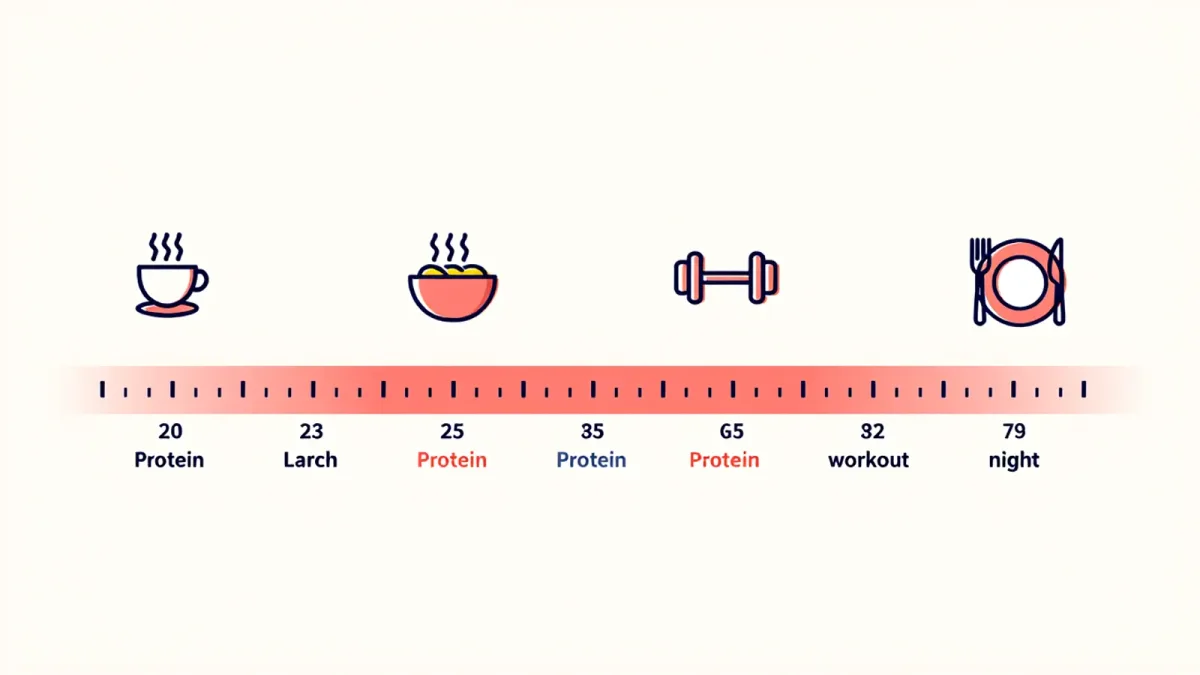
The actionable upgrade over window-watching is distribution. Schoenfeld and Aragon's later 2018 recommendation in the same journal — roughly 0.4 grams per kilogram of body weight per meal, across four meals, to reach about 1.6 grams per kilogram daily — gives muscle-building diets both a total and a rhythm. For an 80-kilogram trainee, that is about 30 grams at each of four sittings, a target ordinary food meets without shakers: Greek yogurt at breakfast, chicken or tofu at lunch, fish at dinner, cottage cheese or legumes late.
The upper boundaries remain contested — some trials suggest larger single doses still contribute to daily synthesis — but no serious reading of the evidence turns distribution into a cliff's edge. Missing one meal does not dismantle a week.
Does any of this matter if you train fasted?
Perhaps, modestly. Fasted morning training removes the pre-exercise amino acids the review considered protective, making post-training protein more than an afterthought. Even here, the deadline is elastic — within an hour or two, not within minutes. Trainees who prefer empty-stomach sessions are best served by a protein-containing meal soon after, and everyone else by not worrying at all.
- Fix the total first: about 1.6 grams per kilogram daily is the evidence-backed anchor for muscle growth.
- Spread it across three to five meals of 25 to 40 grams each.
- Train fasted? Eat a protein meal within a couple of hours afterward.
- Ignore countdown timers — no study has ever shown minute-level cutoffs for fed trainees.
The verdict, plainly: the anabolic window as popularly sold is a myth, retired by research on its own terms. What remains is sturdier and less stressful — a daily protein target, spread sensibly across meals, metabolized on the unhurried schedule of a body that has never heard of a stopwatch. Trainees who internalize the trade recover the most valuable resource any nutrition strategy ever spends: attention spent on totals rather than timers, and dinners eaten calmly after training instead of frantically before the clock could judge them.