The honest verdict: a silk pillowcase is a pleasant, low-friction surface whose mechanical case for hair is plausible, while its skin claims — anti-aging, anti-acne, wrinkle prevention — have no published randomized-trial support. Quality mulberry silk charmeuse is graded by weight at 19 to 25 momme per the textile trade's standard measure, and that smoothness is real. What no manufacturer has produced is a clinical study showing it changes skin.
Hair loss, persistent breakage, or acne are conditions for a dermatologist, not a bedding purchase.
What does silk actually do differently from cotton?
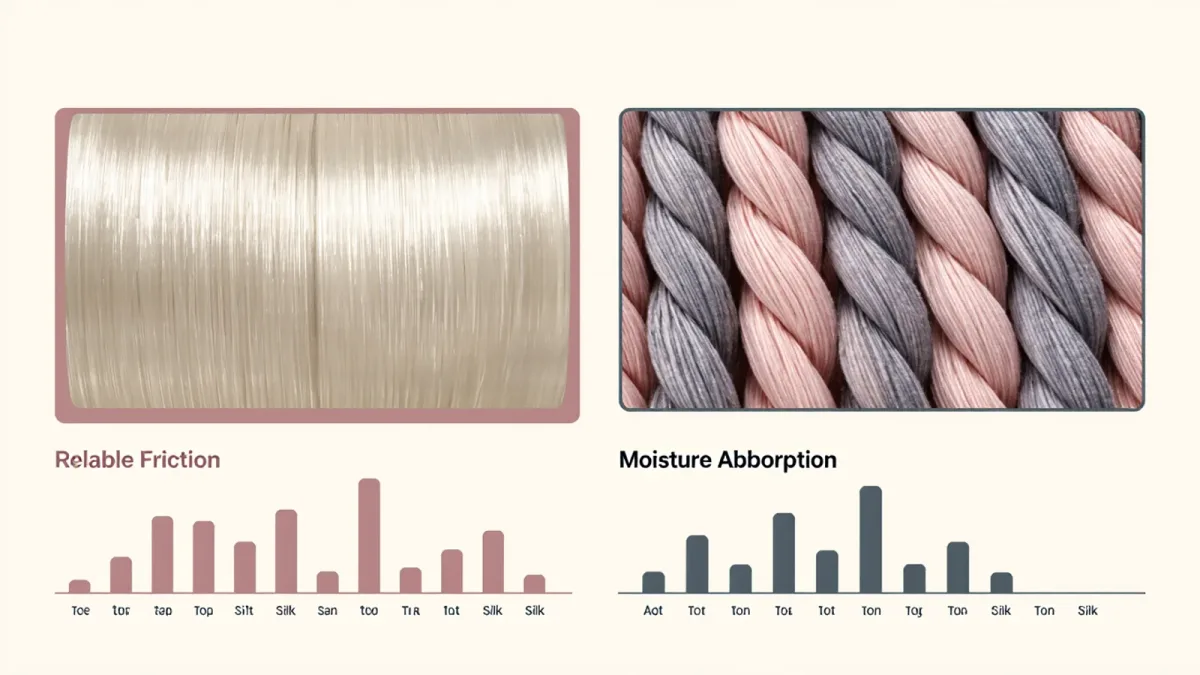
Two things, both measurable in the materials lab. Friction first: silk's long, smooth protein fibers — fibroin coated in sericin — present a far smoother surface than cotton's short, twisted cellulose fibers, so hair and skin glide rather than drag. Absorption second: cotton is highly absorbent and wicks water and lipid from whatever touches it, while silk absorbs far less, leaving night creams on the face and natural oils in the hair to a greater degree.
Those are properties of the fabric, and they are true. The commercial leap happens afterward: every marketed benefit is a prediction about what those properties should produce over months of sleep, and predictions of that shape usually require trials to be believed.
Can a silk pillowcase reduce hair breakage?
The mechanism is reasonable and the direct evidence is thin. Trichology sources identify friction and mechanical stress among the causes of weathering and breakage, particularly in chemically treated, curly, and fragile hair types — the Mayo Clinic's hair-loss materials list mechanical damage among aggravating factors. A smoother surface should reduce the drag that tangles and snaps strands overnight, and stylists' consistent endorsement reflects observed experience, not trial data.
Fair reading: for people who wake with tangled, frizzed lengths, silk plausibly helps, and the downside is only financial. For actual hair loss — shedding from telogen effluvium, androgenetic thinning — no pillowcase changes the biology, and marketing that blurs breakage with loss is doing the blurring on purpose.
Do silk pillowcases prevent wrinkles?
This is the claim with the least support. Sleep wrinkles — the compression lines from pressing a face into a pillow for hours — are real and well-described in dermatology, including a 2016 review in Aesthetic Surgery Journal by Anson and colleagues on sleep lines and their role in facial aging. The theory behind silk is that it moves with the face and distributes pressure, reducing the creasing that cotton grips.
What is missing is any trial showing a silk surface produces fewer or shallower sleep lines over time. And even the theory's advocates note the deeper problem: sleep lines fade in the young and become etched with repetition over decades, so a bedding change in midlife arrives after most of the cumulative exposure. No pillowcase reverses etched lines; at most, the argument runs, it adds less.
The category in one sentence: true fabric physics, forward-projected benefits, zero randomized trials — a pattern that describes a great deal of the beauty aisle.
What about acne and hygiene claims?
Mixed mechanics, unverifiable outcomes. Silk's low absorption means less sebum and product residue held against the skin night after night, and less friction may matter for skin already inflamed. But acne is driven by hormones, follicular occlusion, Cutibacterium acnes, and genetics — none of which a fabric touches. Any bedding material accumulates bacteria and oil and needs frequent laundering; a silk case washed weekly beats a cotton one washed monthly on hygiene, but that is a laundry comparison, not a silk one.
| Claim | Mechanical basis | Clinical evidence |
|---|---|---|
| Less hair breakage | Strong (low friction) | None directly; consistent with trichology |
| Fewer sleep wrinkles | Plausible (less compression grip) | None directly |
| Acne improvement | Weak | None; acne drivers untouched |
| Keeps skincare on skin | Strong (low absorption) | Materials property, not an outcome study |
Is real silk worth the price over satin?
For the friction benefit, probably not. "Satin" describes a weave, not a fiber, and a high-quality polyester satin has a similarly smooth, low-friction surface at a fraction of the cost — often under $20 against well over $60 for mulberry silk at 22 momme. Silk's advantages are fiber naturals: breathability, temperature feel, and lower absorption, plus the washability question, since many polyester satins tolerate machine washing better than delicate silk. Consumers paying for silk are paying for the fiber; consumers paying for less friction can stop at satin.
Care realities deserve a line too. Real silk usually wants hand-washing or a delicate cycle with pH-neutral detergent, air-drying away from sun, and replacement sooner than cotton on a busy rotation. Buyers who will not maintain it should count the cost honestly: a silk case that degrades into a rough one delivers neither the fiber's feel nor its friction argument, at cotton prices multiplied.
The bottom line
Silk pillowcases sell one genuine, verifiable property — a smooth, low-absorption surface — and attach to it a wish list of skin and hair outcomes that no published trial has tested. Breakage-prone and chemically treated hair has the strongest plausible case; wrinkle and acne claims should be read as marketing. A polyester satin delivers most of the mechanics for a quarter of the price, and no pillowcase of any fiber replaces a dermatologist for hair loss or persistent breakouts.