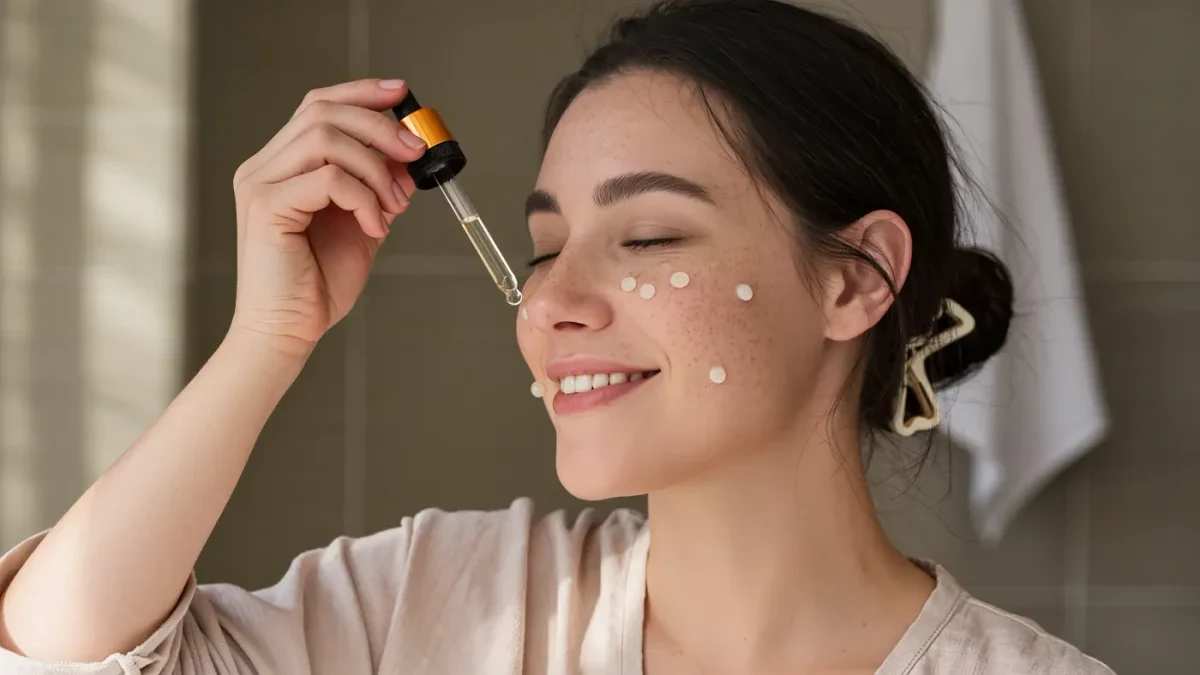

The order that dermatology guidance supports is short: cleanse, apply treatment, moisturize, then sunscreen last. A morning routine of three to five steps applied thinnest to thickest covers the essentials, and the American Academy of Dermatology's sun-safety guidance, updated in 2023, frames broad-spectrum SPF 30 as the baseline for the final step — the one with the strongest evidence in the entire sequence.
Order and layering questions are cosmetic and practical; a persistent rash, suspected reaction, or any diagnosed skin condition belongs with a dermatologist or another clinician.
Why does order matter at all?
Two practical reasons, and neither is mysterious. First, penetration: lightweight, water-based formulas sit closest to the skin and diffuse best through it, while heavier creams and silicones form a partial occlusive film. If a heavy moisturizer goes on first, a lighter serum applied over it may struggle to reach the skin at all. Second, interference: an active ingredient diluted into a thick cream before it has been absorbed delivers less of itself where it is meant to work.
The classic pharmacy formulation principle — apply from thinnest to thickest texture — is the entire logic in one line. Formulators design serums to penetrate and creams to sit on top; using them in reverse quietly cancels part of the design.
What is the correct morning order, step by step?
- Cleanser (optional in the morning). If skin is dry or the evening routine was gentle, a rinse with lukewarm water is a legitimate choice. Over-washing strips lipids the skin then has to rebuild.
- Treatment serum, if you use one. Vitamin C derivatives, niacinamide at typical published concentrations of 2–5%, or other leave-on treatments go onto clean, still-slightly-damp skin.
- Eye product, if used. Generally before heavier creams, for the same thin-to-thick logic.
- Moisturizer. A humectant-and-occlusive layer that seals the steps beneath it.
- Sunscreen, always last. Broad-spectrum SPF 30 or higher, applied generously — the amount that matters is roughly a nickel-sized dollop for the face per AAD consumer guidance, reapplied through the day when exposure is sustained.
Sunscreen goes last because most formulations are designed to form an even film on the skin's surface. Makeup or moisturizer pressed over it can disturb that film, which is why the practical advice is sunscreen, then makeup if any.
Does vitamin C go on before or after moisturizer?
Before. Vitamin C serums are water-light and absorb best on clean skin; moisturizer after them acts as the seal. The evidence on L-ascorbic acid — a 2013 review in the Journal of Clinical and Aesthetic Dermatology by Pumori Saokar Telang summarized photoprotective effects at concentrations of 10–20% in a low-pH vehicle — supports the ingredient at specific parameters, not every product sold under its name. A brand's own claims about its vitamin C serum are the brand's claims, and the concentration and pH on the label are the only parts a consumer can verify directly.
How long should you wait between steps?
Thirty seconds to a minute between layers is enough in most cases, per common clinical guidance, because the point is simply to let each layer set rather than to wait for any chemical process. The often-cited "wait 15 minutes after vitamin C" rule has no strong published basis; what matters more is not rubbing the layers together aggressively before the first has absorbed.
The one genuine exception is sunscreen. Some dermatology sources suggest applying it as the final step and giving it a few minutes before makeup, purely so the film settles undisturbed.
What does the evidence say about the whole routine?
Honestly: most of the layered middle of a ten-step routine has thin evidence, and the ends of the routine carry nearly all of it. Cleansing and sun protection are the two steps with unambiguous support; sunscreen's role in preventing photoaging and skin cancer is among the best-documented in dermatology, including a 2013 randomized trial in the Annals of Internal Medicine by Hughes and colleagues that found daily sunscreen use slowed visible skin aging in adults under 55.
Everything else — the antioxidant serum, the essence, the facial oil — is optional architecture around those two. The National Library of Medicine's consumer resource MedlinePlus summarizes skin care plainly: gentle cleansing and sun protection are the core; the rest is preference and budget.
| Step | Evidence weight | Note |
|---|---|---|
| Sunscreen SPF 30+ | Strong | Randomized trials support daily use |
| Gentle cleansing | Strong | Consensus guidance |
| Vitamin C or niacinamide serum | Moderate | Ingredient- and concentration-dependent |
| Essences, mists, oils | Weak | Largely cosmetic pleasure, not documented outcomes |
Does the order change if you wear makeup?
Only at the end. The sequence up to moisturizer stays the same; sunscreen follows moisturizer, and makeup goes after sunscreen. Products marketed as hybrids — tinted moisturizers with SPF — are legitimate time-savers if they deliver the full applied dose, which most people under-apply; using them as a replacement for a dedicated sunscreen generally means less protection than the label number implies.
The bottom line
The morning order that the evidence supports is a short one: cleanse or rinse, treat, moisturize, protect. The sequence exists so that light formulas can reach skin and heavy ones can seal — thinnest to thickest — and so that sunscreen, the step with real randomized-trial backing, sits undisturbed on top. Everything else in the cabinet is negotiable.