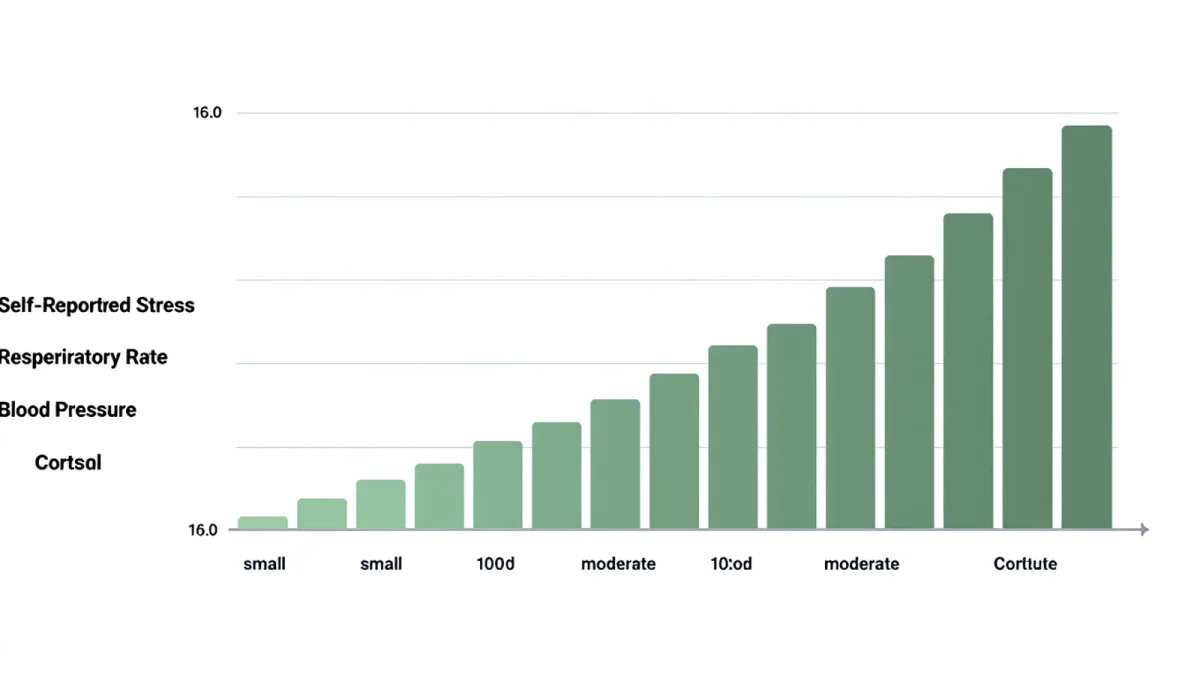
Short answer: the best-controlled breathwork studies show modest, measurable reductions in self-reported stress and anxiety, with physiological effects — slower breathing rate, small drops in blood pressure and cortisol — that are real but smaller than the marketing. A 2023 randomized trial in Cell Reports Medicine, tracking 108 participants practicing five minutes daily for a month, found that one pattern in particular — the cyclic sigh, two inhales through the nose followed by a long exhale — improved positive mood and reduced respiratory rate more than an equal stint of mindfulness meditation. That trial is the strongest recent anchor in a field of uneven studies.
Breathwork is not a treatment for anxiety disorders, panic disorder, or PTSD; those belong with a clinician, though some clinicians add breathing training as a supporting tool.
What counts as breathwork?
The term covers everything from slow diaphragmatic breathing taught in cardiac rehab to hyperventilation-style sessions popular in studios. Research divides them sharply. Slow-breathing practices — roughly 5 to 7 breaths per minute, with extended exhales — have the bulk of the trial evidence. Rapid or hyperventilating formats have far less controlled data and carry documented risks: dizziness, tingling, and, in susceptible people, triggering of panic or fainting. Any fair reading of the literature treats these as different interventions that happen to share a word.
How big are the effects?
A 2019 systematic review of slow-breathing randomized trials — indexed through the National Institutes of Health — found consistent reductions in self-reported anxiety and arousal, with physiological markers moving in the same direction but modestly. Meta-analyses of slow-breathing interventions published through 2023 generally report standardized effect sizes in the small-to-moderate range, commonly around 0.3 to 0.5 — comparable to other relaxation techniques, such as progressive muscle relaxation, and smaller than the effects reported for first-line treatments like cognitive behavioral therapy for diagnosed anxiety. The 2023 Cell Reports Medicine trial deserves its specific numbers: after a month, the breathwork groups showed greater improvement in positive affect and lower resting respiratory rate than the meditation control, with the cyclic sigh pattern performing best among three patterns tested.
| Outcome | Typical finding in slow-breathing trials | Evidence quality |
|---|---|---|
| Self-reported stress/anxiety | Small-to-moderate reduction (d ≈ 0.3–0.5) | Consistent across reviews |
| Respiratory rate | Reliable reduction toward 5–7 breaths/min during practice | Strong, measured directly |
| Blood pressure | Small reductions, mostly in hypertensive groups | Mixed across trials |
| Cortisol | Modest acute decreases; chronic changes unclear | Preliminary |
| Diagnosed anxiety disorders | No evidence of standalone efficacy | Not established |
Why would slow breathing change anything?
The mechanism most researchers cite is autonomic: slow breathing with extended exhales increases vagal activity and respiratory sinus arrhythmia — the natural speeding and slowing of heart rate around each breath — shifting the balance toward the parasympathetic state measured as heart-rate variability. Exhale-weighted breathing also stimulates baroreceptors, which partially explains the small blood-pressure responses documented in experimental physiology work. This is uncontroversial physiology; what remains debated is whether short daily practice durably reshapes baseline stress reactivity or only the minutes around the practice itself.
Does one technique beat another?
Head-to-head comparisons are scarce, which has not stopped confident studio claims. The 2023 trial is the notable exception, and it favored the cyclic sigh over box breathing and cyclic hyperventilation for mood outcomes. Its design limits matter: five-minute app-guided sessions, online enrollment, self-reported outcomes, and a young, healthy sample. A 2023 review of breathwork meta-analyses concluded that heterogeneity across techniques, durations, and populations remains the field's central problem — the average effect size conceals studies that found little alongside studies that found a lot.
How does breathwork compare with meditation?
The 2023 trial compared the two directly, which most studies never do. Over a month of five-minute daily sessions, all three breathwork patterns beat mindfulness meditation on positive affect gains, and respiratory-rate improvements tracked the subjective reports. The authors’ interpretation is mechanistically sensible: meditation trains attention while breathing patterns act directly on autonomic state, so the two interventions overlap less than their shared wellness-category placement suggests. For someone deciding how to spend ten stress-management minutes, the trial’s data favor exhale-weighted breathing for immediate state change and leave open whether meditation wins on longer-horizon measures it was built to train. Both trials and reviews note that adherence was unusually good — five minutes is a small ask, and practices that clear that bar tend to accumulate benefits in ways ambitious protocols do not.
What should a skeptical reader conclude?
The honest summary: slow, exhale-weighted breathing is a free, low-risk practice with consistent small-to-moderate evidence for acute stress reduction, anchored by decent physiology and a reasonable set of trials. Claims beyond that — detox, adrenal resets, trauma release — sit well outside the data. And the contrast with treatment matters in a city where anxiety disorders are common: breathing exercises complement evidence-based care; they do not replace it.
The bottom line
Expect effect sizes of roughly 0.3 to 0.5 on self-reported stress from slow-breathing practice — real, useful, and modest. The five-minute daily cyclic sigh from the 2023 Cell Reports Medicine trial is the best-specified protocol the current literature offers.