Short answer: desk stretches have real but narrow evidence — they improve immediate discomfort and range of motion, and specific programs reduce reported neck and shoulder pain in office workers, with reductions around 40 to 50 percent in the best trials. What stretching does not do, per the research, is undo the metabolic and cardiovascular consequences of prolonged sitting. A 2016 meta-analysis in the Scandinavian Journal of Work, Environment & Health covering strength-training trials for office workers found regular specific resistance exercise — not stretching alone — produced the most durable pain reductions over the following months.
Pain that radiates down an arm or leg, numbness, or symptoms persisting beyond a couple of weeks belong with a clinician or physical therapist, not with a stretch routine.
What actually happens to a body at a desk?
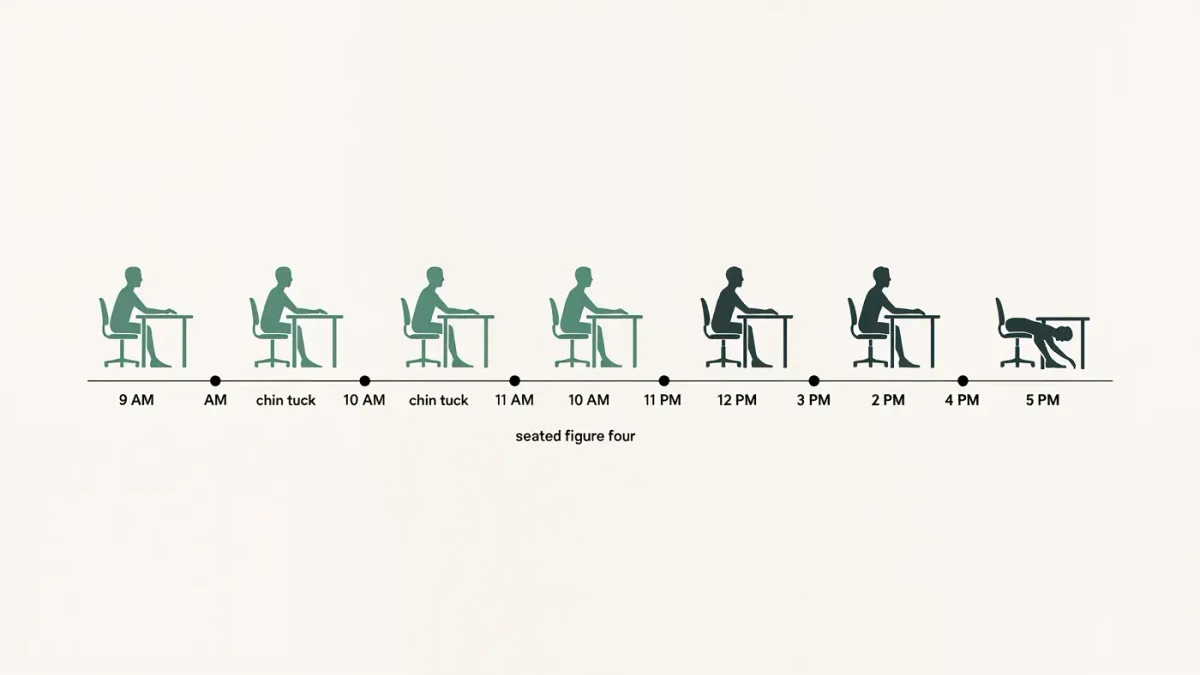
The office-day posture story has two documented layers. The musculoskeletal layer: sustained positions — especially forward head and rounded shoulders over a laptop — raise reported neck, shoulder, and low-back discomfort, and survey data across occupational-health literature put neck pain prevalence among office workers at roughly 40 to 60 percent in a given year. The metabolic layer is separate and larger: prolonged uninterrupted sitting associates with elevated post-meal glucose and insulin, reduced lipoprotein lipase activity, and, in cohort analyses, higher cardiovascular and all-cause mortality risk — associations a hamstring stretch does not touch. Conflating the two layers is where most desk-stretch marketing goes wrong.
Do stretches reduce neck and shoulder pain?
The specific-evidence answer is yes for structured programs, less so for occasional ad-hoc stretching. Trials summarized in that 2016 meta-analysis — and in a 2019 systematic review of workplace interventions published in the Journal of Occupational Health — found that regular strength training for neck and shoulder muscles, performed at the office two to three times weekly, reduced reported pain substantially and persistently, while most stretching-only programs produced smaller and shorter-lived effects. A frequently cited Danish trial, the Danish National Research Centre for the Working Environment studies of the 2000s, showed ten weeks of specific strength training cut neck pain roughly in office workers with chronic symptoms by around 40 percent, with gains maintained at follow-up. Stretching served in those trials mainly as a warm-up and comfort measure, not as the active ingredient.
| Intervention | Evidence | Typical finding |
|---|---|---|
| Strength training (neck/shoulders) | Multiple RCTs, meta-analyzed 2016 | 40–50% reported pain reduction, durable |
| Stretching-only programs | Smaller trials | Short-term comfort, limited durability |
| Breaking up sitting | Lab studies, 2015–2023 | Lower post-meal glucose and blood pressure |
| Standing desks alone | Mixed trials | Small effects; substitution, not movement |
Can stretching undo the harms of sitting?
No — and this is where the hype peaks. The metabolic consequences of sitting respond to muscle contraction, not to elongation. Landmark crossover studies by Cornell's Matthew Buman and by researchers at the University of Queensland in 2012–2015 showed that brief walking breaks every 30 minutes measurably lowered post-meal glucose and blood pressure compared with uninterrupted sitting; movement, not position change, drove the effect. The National Institutes of Health occupational-health summaries reach the same practical conclusion: the evidence-supported desk habit is frequent light activity — a two-minute walk each half hour outperforms a perfect posture held for four hours.
Is "good posture" itself proven?
Less than assumed. A widely discussed 2019 systematic review in the Journal of Orthopaedic & Sports Physical Therapy found no consistent association between spinal posture variations and low back pain in healthy people — the idea that one neutral sitting position prevents pain is weaker in the data than in ergonomic folklore. Movement variability, the evidence suggests, matters more than any single position. Stretching fits that finding naturally: not because it corrects a bad posture, but because it inserts motion into a static morning.
Why do office trials matter more than lab studies here?
Because the two measure different things, and the gap explains conflicting headlines. Laboratory studies of a single stretch document immediate changes in tissue extensibility and perceived tension — both real. Workplace trials track what happens to reported pain over ten weeks to a year of actual office life, which is where stretching-only programs thin out: people stretch less often than prescribed, loads are never added, and comfort returns fade. The strength-training programs that held their gains shared three features — progressive resistance, two to three fixed weekly sessions, and enough supervision at the start to confirm the exercise was actually loading the target muscles. That combination, not any single movement, is the transferable finding from the Danish and Scandinavian trials.
What a research-aligned desk routine looks like
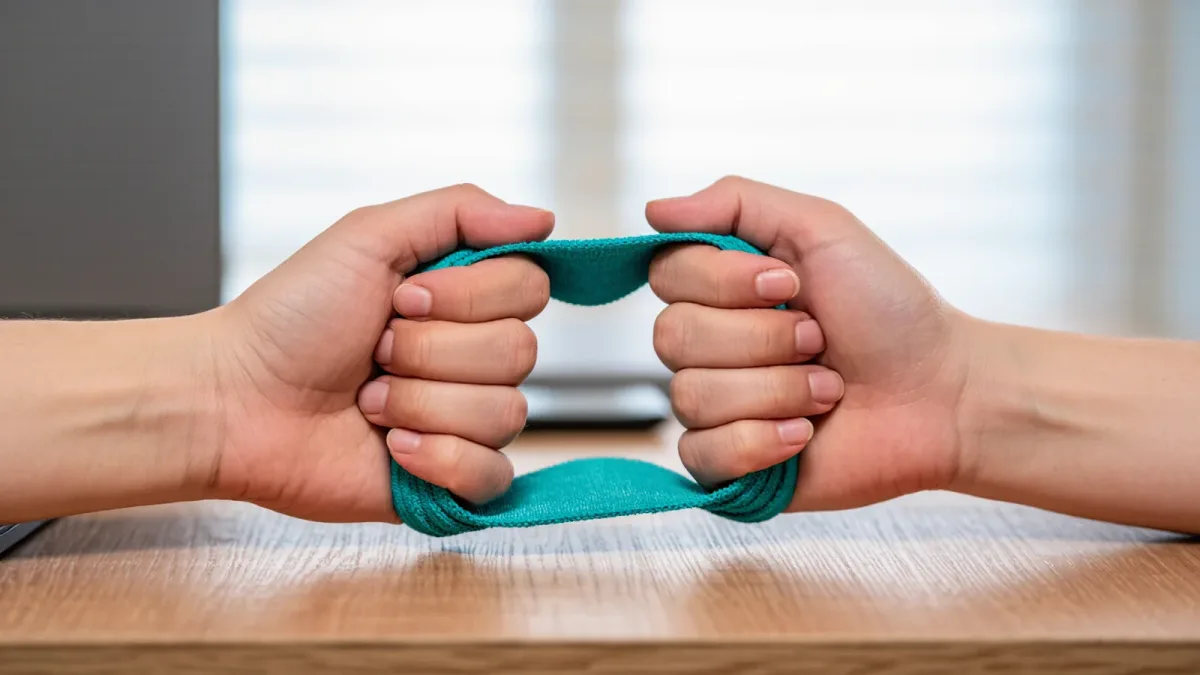
Reconstructed from the trials rather than from tradition: twice-weekly sessions of specific strength work for the neck, shoulders, and upper back — the dose the durable pain-reduction studies used — plus movement breaks every half hour, plus any stretch you find relieving as a short-term comfort measure. That hierarchy follows the effect sizes: strength first, frequency of movement second, stretching third. None of it requires equipment beyond a resistance band, and the trials show office compliance is feasible in five-minute blocks.
The bottom line
Desk stretches are neither worthless nor sufficient. Expect honest, immediate relief and modest flexibility gains; expect durable pain change from strength training at two to three sessions weekly, and metabolic protection from getting up roughly every half hour. The 2016 meta-analysis numbers — around 40 to 50 percent pain reduction — belong to the strength work, not the stretch.