
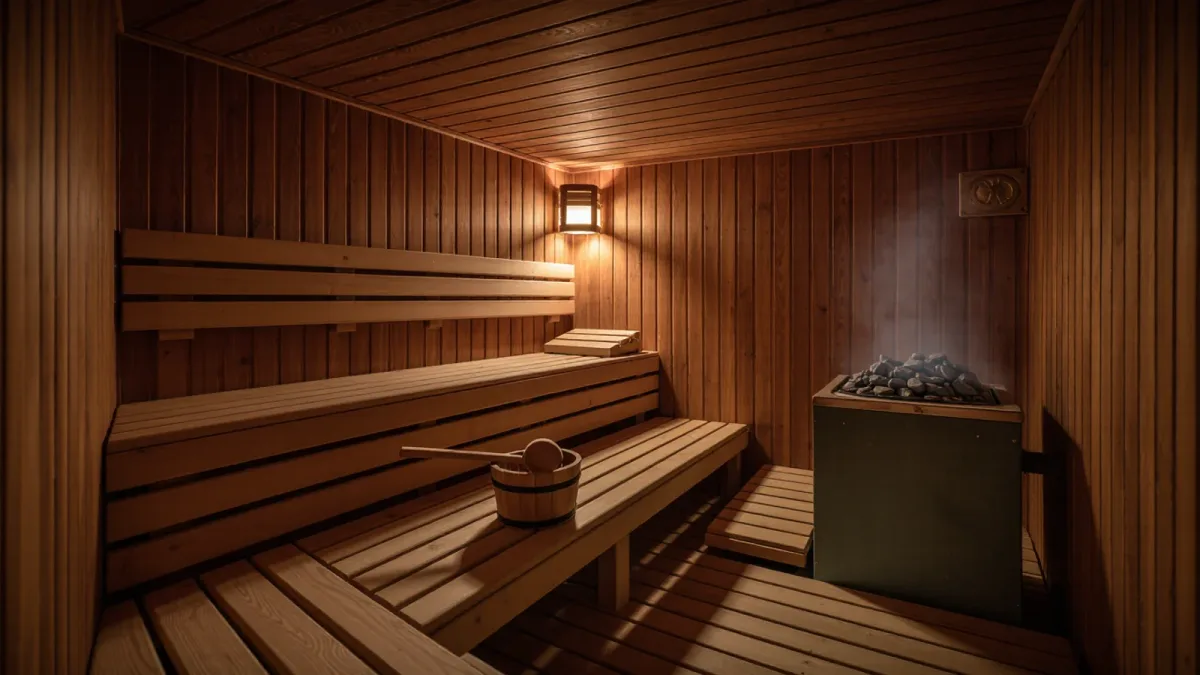
Short answer: observational data link frequent sauna bathing to meaningfully lower cardiovascular risk. In the best-known analysis — a 2015 cohort study of 2,315 middle-aged Finnish men in JAMA Internal Medicine, indexed through the National Institutes of Health — men who used a sauna four to seven times a week had roughly half the risk of fatal cardiovascular disease and sudden cardiac death compared with once-a-week users over a median follow-up of about 20 years. That is the anchor number behind most sauna marketing, and it deserves a careful read before it becomes a habit.
Anyone with unstable angina, a recent heart attack, severe aortic stenosis, or low blood pressure episodes should discuss sauna use with a clinician before starting — the cardiac workload of a hot room is real.
What did the Finnish cohort actually measure?
The Kuopio Ischaemic Heart Disease Risk Factor Study followed middle-aged men in eastern Finland, a region with a deep sauna culture, from the 1980s onward. Researchers classified sauna frequency by self-report at baseline and tracked fatal events through national registries. Beyond the headline four-to-seven-times finding, the 2015 paper reported a dose-response pattern: two to three weekly sessions showed intermediate risk, and longer sessions — 19 minutes or more versus under 11 — associated with lower risk than short ones. A 2017 follow-up in the same cohort, published in BMC Medicine, linked frequent sauna use to lower risk of hypertension, and a 2018 analysis in Mayo Clinic Proceedings, covering both Finnish cohorts and broader literature, reviewed plausible mechanisms.
Why correlation is not yet prescription
Three limits matter, and the study authors name them. First, confounding: frequent sauna users in the cohort were younger, leaner, more physically active, and had better baseline fitness than once-a-week users — characteristics independently tied to cardiac risk, and only partially corrected by statistical adjustment. Second, self-reporting: baseline frequency was captured once, by questionnaire, and habits change over two decades of follow-up. Third, geography and culture: the findings come from Finnish men using dry saunas at roughly 80–100°C, and extending them to infrared lounges at 55°C, or to women — whose representation in the cohorts was minimal — is extrapolation. A 2018 review co-authored by researchers from the University of Eastern Finland argued the mechanism evidence is plausible but conceded the causal question is unsettled.
| Study | Population | Finding |
|---|---|---|
| JAMA Internal Medicine, 2015 | 2,315 Finnish men, ~20-year follow-up | 4–7 sessions/week: ~50% lower fatal CVD and sudden cardiac death vs 1/week |
| BMC Medicine, 2017 | Same cohort, 1,621 men | 4–7 sessions/week: ~46% lower hypertension risk vs 1/week |
| Mayo Clinic Proceedings, 2018 | Review of cohorts and mechanistic work | Plausible cardiovascular mechanisms; causal proof lacking |
What are the proposed mechanisms?
Passive heat stresses the cardiovascular system in ways that mimic — at reduced intensity — moderate exercise: heart rate rises to 100–150 beats per minute in a hot Finnish sauna, cardiac output increases, and skin vessels dilate. Repeated exposure, the mechanistic literature proposes, improves endothelial function, reduces arterial stiffness, and lowers blood pressure, effects documented in small experimental studies of repeated sauna sessions. Cardiac rehabilitation programs in Japan have used thermal therapy — a gentler 60°C sauna format called Waon — in supervised settings since the 1990s, with small trials reporting improved vascular function. These mechanisms are coherent and tested in small samples; they have not been validated at the population scale the cohort data imply.
What does a session actually do to blood pressure?
Acutely, blood pressure typically falls after a sauna as vessels dilate, though it can dip enough to cause lightheadedness — the reason standard safety guidance recommends hydration, avoiding alcohol, limiting sessions to 15–20 minutes in traditional dry saunas, and cooling down gradually. A 2018 experimental study of sauna followed by cold water immersion in Finnish men, published in the American Journal of Physiology, documented transient blood-pressure rises during the cold plunge phase — a detail relevant to readers combining both practices in New York's contrast-therapy studios.
How does this translate to a city of gyms and bathhouses?
New York's options differ from the Finnish template: Korean and Russian bathhouses, infrared cabins in boutique studios, and gym saunas at varying temperatures and humidity. The cohort evidence covers hot, dry, relatively long sessions, not 15 minutes in a 55°C infrared pod, and no comparable long-term cohort exists for infrared or for the short sessions common in commercial studios. Readers using saunas as one habit among several are aligned with what the data describe — the Finnish sauna users were, in aggregate, active people, and the researchers themselves note the associations may partly reflect an overall health-conscious pattern.
The bottom line
The observational evidence is unusually consistent — two decades of follow-up, a dose-response pattern, and plausible mechanisms — but it is still observational. Four or more sessions weekly is the exposure linked to the strongest risk reductions in Finnish men; no trial has tested whether adopting that schedule lowers cardiac risk in someone else. Treat the sauna as a promising, low-risk habit for most healthy adults, not as a proven therapy — the difference between those two framings is exactly the difference between a cohort and a clinical trial.