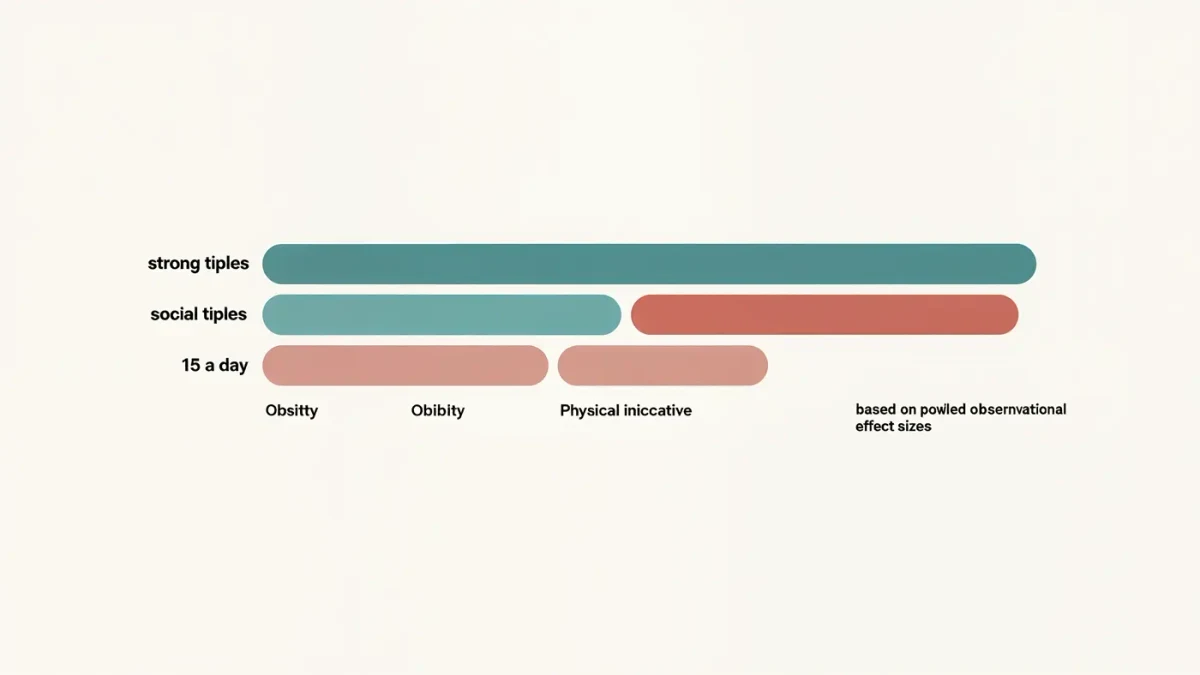

Short answer: social connection is among the better-documented predictors of long life in the epidemiological literature. A 2010 meta-analysis by Julianne Holt-Lunstad and colleagues in PLOS Medicine, covering 148 studies and 308,849 people, found that adults with stronger social relationships had a 50 percent higher probability of survival over the average follow-up period than those with weaker ties — an effect the authors calculated as comparable to quitting smoking and larger than the effects of obesity or physical inactivity. A 2015 update in the same journal, spanning 70 studies and more than 3.4 million participants, confirmed the pattern for loneliness, social isolation, and living alone.
Persistent loneliness that accompanies depression, anxiety, or grief is a clinical matter, and a clinician is the right first stop.
How strong is this evidence, really?
It is observational, and unusually large. The Holt-Lunstad analyses pool prospective cohorts — studies that measure connection at baseline and track mortality for years — across four continents, with adjustments for age, health status, and smoking. A 50 percent survival difference held across mean age groups and follow-up lengths, which is why the 2023 advisory from the US Surgeon General, titled "Our Epidemic of Loneliness and Isolation," cited this literature in ranking social disconnection alongside smoking and inactivity as a mortality risk factor. What no study has shown is causation in the trial sense: there is no randomized experiment that adds friends to one group and withholds them from another. Reverse causality — illness shrinking social lives rather than isolation causing illness — is handled statistically, imperfectly.
What are the proposed mechanisms?
Three threads appear repeatedly in the biology literature. Stress buffering: close ties dampen physiological responses to stressors, with studies of social support showing lower cortisol reactivity. Health behavior: connected people are more likely to be held to routines — meals, appointments, movement — by the people around them. And inflammation: cohort studies summarized by the National Institutes of Health associate chronic loneliness with elevated inflammatory markers such as C-reactive protein and interleukin-6. None of these threads is a complete causal chain, but they point the same direction. The European Social Survey work of epidemiologists at University College London, published in 2013, adds a nuance the headline number misses: satisfaction with one's social life predicted survival more strongly than contact frequency alone, suggesting the subjective sense of being supported carries much of the signal.
| Marker | Effect size in the literature | Comparable to |
|---|---|---|
| Strong social ties (2010 meta-analysis) | +50% survival probability | Quitting smoking |
| Loneliness, isolation (2015 meta-analysis) | 26–32% increased early-death risk | Obesity, inactivity |
| Living alone (2015) | 32% increased risk, higher in younger adults | Established risk factors |
Why New York is a useful lens
The city concentrates both sides of the finding. Census data have long shown that roughly a third of New York City households are a single person living alone — among the highest shares in the country — and density itself does not produce connection; a 2018 analysis by Cigna's research arm (brand-funded, worth naming as such) found loneliness roughly similar across urban and rural America. Yet the same city supplies what the longevity literature rewards: walkable neighborhoods where errands produce repeated low-stakes contact, dense congregational and cultural institutions, public parks programmed for group activity, and the spontaneous ties of commutes and corner stores. Sociologists call these weak ties, and a 2022 study in the Journal of Personality and Social Psychology found that even brief conversations with strangers measurably raised mood for both parties — the minimal unit of the effect.
Does quality matter more than quantity?
Yes, with a wrinkle. The meta-analytic data treat connection as a broad dimension, but the cohort work on marital quality shows that strained relationships carry health costs — a 2013 review in Psychosomatic Medicine documented links between marital conflict and cardiovascular markers. The practical reading most researchers offer: a few reliable ties beat many shallow ones, and a demanding social calendar is not the intervention.
What actually moves the needle?
Interventions are the weak point of the field, and honesty requires saying so. Reviews of loneliness interventions — group activity programs, befriending services, social prescribing as practiced by the UK's National Health Service — show modest, inconsistent effects, in part because dropping a lonely person into a program does not manufacture a durable relationship. The elements that fare best in reviews are recurring, purposeful contact: volunteering, regular team activities, and groups organized around a shared task rather than around loneliness itself. New York's infrastructure of community gardens, running clubs, houses of worship, and senior centers maps onto that list almost line by line. New York City's own aging-services infrastructure — senior centers operated through the Department for the Aging, the country's largest municipal network — exists in large part because isolation among older adults concentrates in dense neighborhoods where apartment doors stay shut.
The bottom line
A 50 percent survival advantage for the well-connected, replicated across millions in 2010 and 2015, makes social connection one of the largest non-clinical variables in the longevity literature — with the standing caveat that only observational data exist. In a city where a third of households are one person, the repeated, low-effort contact of urban life is not noise; it may be the active ingredient.