
Short answer: one-week digital-detox experiments find modest improvements in self-reported well-being — a 2021 randomized trial from the University of Bath, published in Cyberpsychology, Behavior and Social Networking, tracked 154 adults who quit social media for a week and reported significant improvements in well-being, depression, and anxiety compared with a control group, with an average effect equivalent to moving roughly eight points on common mood scales. The same literature carries two caveats the detox industry usually omits: the benefits shrink after normal use resumes, and restricting one platform rarely reduces total screen time — usage migrates elsewhere on the phone.
Problematic use that accompanies depression or anxiety is a clinical matter, and a clinician — not a detox challenge — is the right starting point.
What do the randomized trials show?
Three studies carry most of the weight. The Bath trial, led by psychologist Jeff Lambert, randomized 154 users aged 18 to 72 to a one-week break from all social media or to continued use, and found the break group improved on well-being, depression, and anxiety measures at one week. A University of Pennsylvania experiment by Melissa Hunt published in the Journal of Social and Clinical Psychology in 2018 took a different design: rather than full abstinence, 143 undergraduates limited Facebook, Instagram, and Snapchat to 30 minutes total daily for three weeks, and that limit group showed significant reductions in loneliness and depression versus a use-as-usual group — with the authors noting reductions in FOMO, the fear of missing out, as a mediating path. A 2022 systematic review by Radtke and colleagues in Mobile Media & Communication assembled the broader field and concluded effects are mixed, samples are small, and follow-up periods are short.
| Study | Design | Finding |
|---|---|---|
| Bath, 2021 | RCT, 1-week full break, 154 adults | Improved well-being, depression, anxiety |
| Pennsylvania, 2018 | RCT, 30-min daily limit, 3 weeks, 143 students | Reduced loneliness and depression |
| Radtke review, 2022 | Systematic review of detox studies | Mixed effects, small samples, short follow-up |
Why would a week off help?
The mechanisms proposed in this literature are social and cognitive rather than toxicological. Upward social comparison — measuring an ordinary Tuesday against everyone's edited highlights — rises with feed exposure, and experimental work summarized in the Penn papers links comparison-heavy platforms to worse mood than connection-heavy use. Sleep displacement is a second thread: late-night scrolling displaces sleep, and the Bath team noted some participants reported better sleep during the break. Neither mechanism requires feeds to be uniquely harmful; both suggest the dose and timing of use, and what it displaces, do the damage.
Do the gains survive the return to normal use?
This is the field's honest weak point. Most trials measure outcomes at the end of the break or shortly after, and the few follow-ups suggest the mood benefits decay once old habits resume — the 2022 review flagged the absence of longer-term data as the central gap. The practical reading: a detox is best understood as an experiment that measures how your own mood tracks with your usage, not as a cleanse that permanently changes anything. Several trial authors say the more durable version is the Penn design — a standing daily limit — rather than periodic abstinence.
Does quitting one app actually reduce screen time?
Often no, and this finding deserves more attention than it gets. Digital-wellbeing research through 2024 consistently shows partial substitution: minutes removed from the banned platform reappear in messaging, video, or news apps, so total device time moves little even when well-being improves. That result reframes what a detox treats. The Bath and Penn gains plausibly came from removing comparison and social-monitoring content specifically — not from reducing screen time as such, which barely changed.
Who has been studied — and who has not?
The demographic limits of these trials matter for how far the findings travel. The Penn sample was undergraduates; the Bath cohort, spanning ages 18 to 72, is the broader of the two, but both overrepresented regular social media users already curious enough to enroll in a screen-time study. Almost no trial has focused on adults over 65, whose relationship to feeds and phones differs in kind, or on adolescents, whose study raises consent complications researchers are still working through. Office workers form another understudied group: constant work messaging sits outside the comparison-feed framing entirely, and a week off email has, notably, never been tested with the rigor applied to a week off Instagram. Expect these boundaries of the evidence to matter more as the workplace messaging layer of digital life grows.
What would a research-aligned week look like?
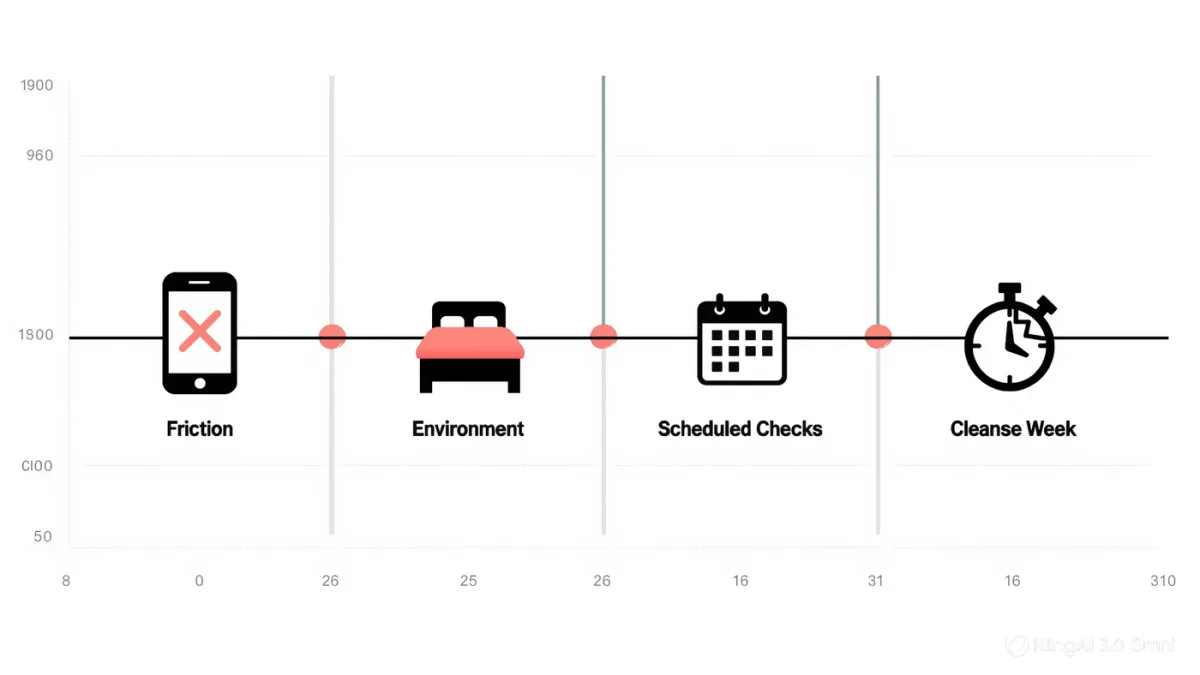
Rebuilt from the trial designs: delete or log out of comparison-heavy social apps for seven days while leaving messaging and maps intact — the Bath protocol; or, less drastically, cap the big three platforms at 30 minutes daily with the phone's own tools, per the Penn study; keep a brief mood note each evening so the week produces personal data rather than vibes; and decide before the week ends which element — the limit, the missing comparisons, the earlier bedtimes — seemed to carry the effect, because the durable version is a habit adjustment, not an annual purge.
The bottom line
The trials support a modest, real one-week effect: improved mood and lower reported anxiety, on the order of the Bath study's findings, with benefits that likely fade unless something structural — a daily cap, fewer comparison feeds, protected sleep — changes afterward. Full abstinence is not required; the 2018 Penn data suggest the 30-minute limit may be the more sustainable intervention.