Yes — for most people, most of the way. Resistance training built comparable muscle and strength whether the tool was a barbell, elastic bands or bodyweight, provided sets were hard and volume matched: a 2015 randomized trial by Calatayud and colleagues in the Journal of Strength and Conditioning Research found push-ups with elastic resistance produced strength gains similar to bench-press training over five weeks. The exceptions arrive later — heavy leg and back loading, and the ceiling that progressive overload eventually hits in a small apartment.
Existing injuries and chronic conditions deserve a clinician's clearance before any program, home or gym, becomes a routine.
The stimulus lives in the last hard repetitions, not in the address of the equipment. Trials that matched those repetitions found the equipment nearly interchangeable.
What do head-to-head trials actually show?
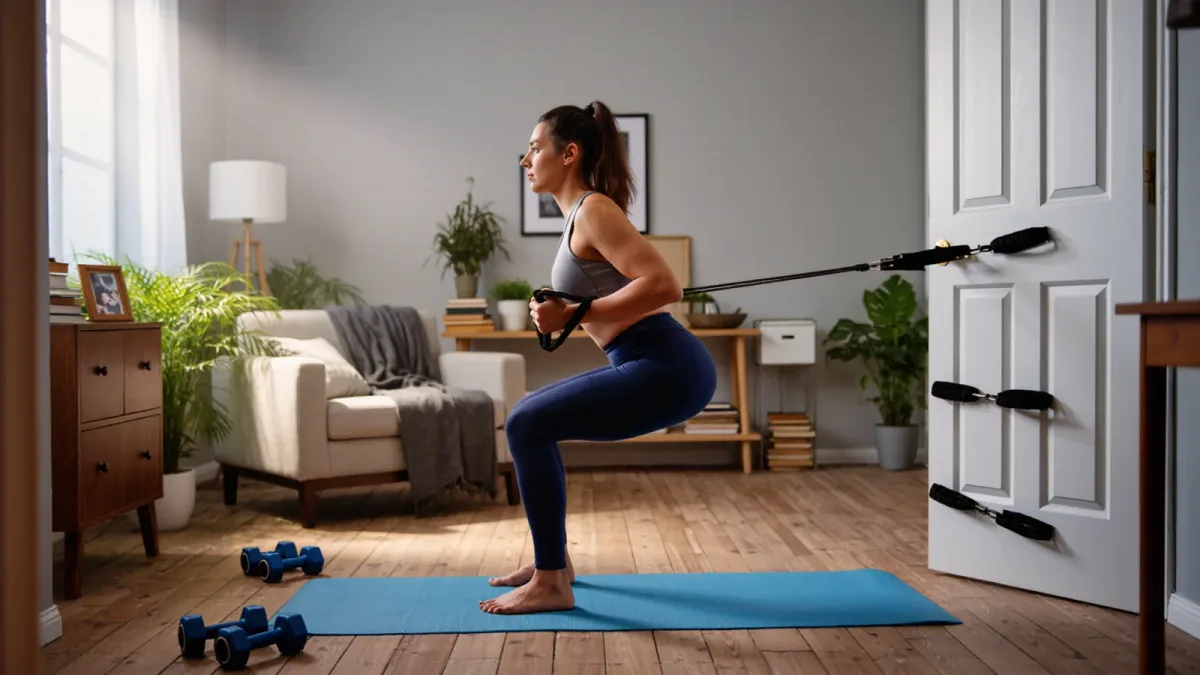
The controlled comparisons cluster around one message: effort and volume outweigh equipment. The elastic-versus-bench trial above is the cleanest example; other work has compared leg-press training with elastic-band squats and reported similar hypertrophy when intensity was matched. Reviewers of training variables — load, tempo, tool — keep returning to the same two masters: proximity to failure and total weekly sets. A band taken to trembling is a stimulus; a dumbbell set down early is not, wherever it lives.
Two honest limits sit inside that conclusion. Trials run weeks to months, not years, so the ceiling question is partly extrapolation. And matched intensity is doing heavy lifting in these comparisons: replicating a near-failure effort at home requires skill, creativity and a tolerance for burning legs.
Where the gym keeps the edge
- Progressive overload at scale: adding load in small increments for years is mechanically simple with plates, awkward with bands and bodyweight.
- Heavy lower-body loading: barbell squats and deadlifts load the hips and spine in ways most living-room kits cannot approach.
- Pulling variety: rows and pull-ups need anchors and height; gyms supply both generously.
None of these is fatal to home training; they are gradients, not walls. But they explain why a committed two-year home trainee usually ends up improvising — weighted vests, adjustable dumbbells, a doorway pull-up bar — a home gym in increments.
| Factor | Home training | Gym training |
|---|---|---|
| Hypertrophy, first year | Comparable when effort matches | Comparable |
| Long-term load progression | Constrained by equipment | Simple, incremental |
| Heavy legs and back | Hard to replicate | Straightforward |
| Adherence and convenience | Strong — no commute | Depends on distance and schedule |
| Cost over a year | Low after initial kit | Membership-dependent |
Where the living room quietly wins
Convenience is not a soft factor; it is adherence, and adherence is the largest effect in the dataset of real training outcomes. The workout that happens beats the workout that requires the B train at rush hour. Home training removes the commute, the waiting-for-the-rack arithmetic and the self-consciousness that keeps many beginners — particularly those over 40, or returning after injury — out of the weight room entirely. Frequency rises, and frequency multiplies volume, which is the variable muscle growth actually tracks.
There is also a dose-shape argument. Short, frequent home sessions — twenty minutes of hard band work most evenings — accumulate a respectable weekly load with none of the scheduling heroics a gym routine demands.
Three home-training myths, checked
The first myth is that bodyweight work can only build endurance, not size — contradicted directly by the trial record above. The second is that muscles need constant novelty: variety helps adherence, but research on periodized programs finds progression of effort, not exercise shuffling, drives growth. The third is that home results require an hour: distributed shorter sessions accumulate comparable weekly volume, and frequency itself has mild evidence in its favor when total sets are held equal.
One myth worth keeping, oddly, is a suspicion of one's own counting. Sets taken “close to failure” at home tend to drift further from failure as fatigue borrows honesty; filming a final set occasionally, or counting repetitions against a fixed standard, restores the calibration the trial conditions enjoyed.
How should a home program be built?
- Train each muscle group two to three times weekly, in line with general resistance-training guidance, roughly 10 or more hard sets per muscle.
- Progress through leverage and tempo when load is fixed: slow eccentrics, single-leg and single-arm versions, pauses, and elevated positions all raise difficulty without new equipment.
- Anchor pulling work early: a doorway or wall-mounted bar repays itself; rows can use a sturdy table edge.
- Buy in one increment: adjustable dumbbells plus long-loop bands cover most pressing, hinging and rowing needs for years.
The verdict, stated plainly: muscle does not know the address of the equipment. The gym's advantage is real but deferred, arriving mainly for advanced legs and long timelines, while home training's advantage — showing up — pays from the first week. The right answer for a given life is often a blend: home on weekdays, iron on weekends.
A final word for the returner rather than the beginner: someone coming back after years away holds a quiet advantage called muscle memory. Trained muscles retain nuclei and neural patterns, and research on retraining shows faster regains than first-time gains. For that reader, the modest home kit is not a compromise; it is precisely the tool the first six months deserve.