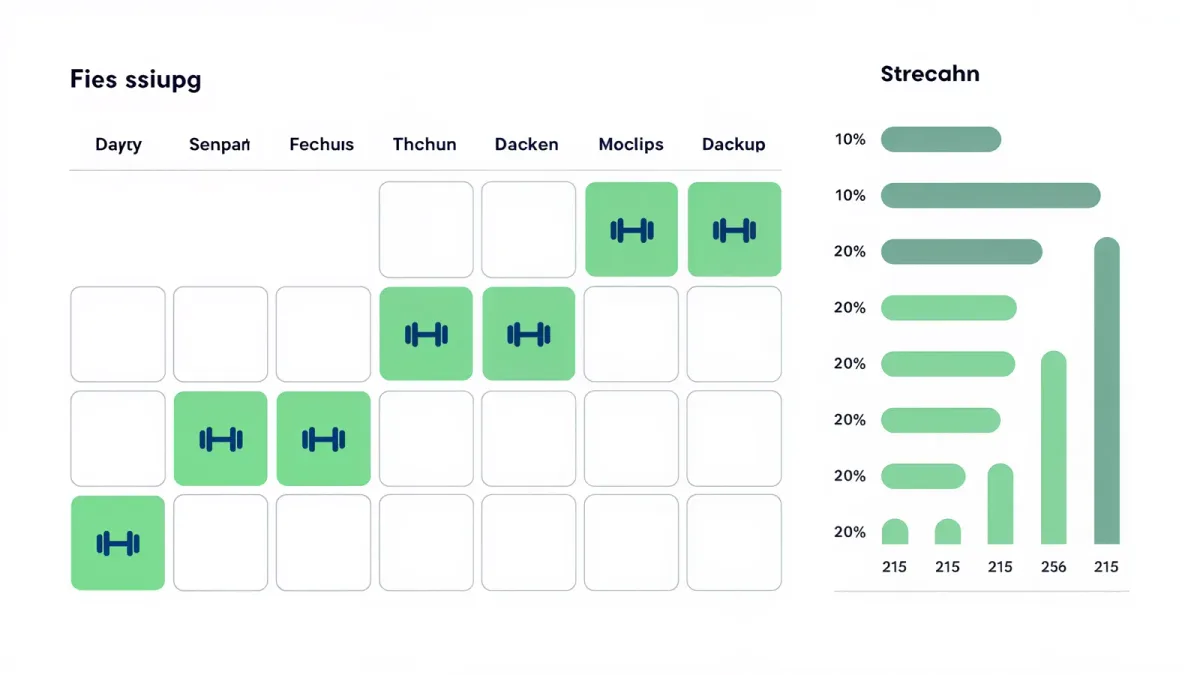

Yes — adults past 40 build measurable muscle and strength on a simple prescription: two to three resistance-training days per week and roughly 10 to 20 hard sets per muscle group across those days. The federal Physical Activity Guidelines, last updated in 2018, ask only two or more muscle-strengthening days weekly, yet a 2017 dose–response analysis by Schoenfeld and colleagues in the Journal of Sports Sciences found muscle growth climbed with weekly set volume, up to a point of diminishing returns.
Joint pain, cardiovascular diagnoses, and decades behind a desk all belong in a conversation with a clinician before loads get heavy — and any program that provokes sharp pain should stop, not scale.
How many days per week should you lift after 40?
Two days is the evidence-backed floor; three is the practical sweet spot. When researchers equalize total weekly volume, frequency itself turns out to matter surprisingly little. A 2016 meta-analysis by Schoenfeld, Ogborn and Krieger in Sports Medicine compared training each muscle one, two or three times per week and found that once the weekly set count matched, hypertrophy differences largely disappeared.
That finding reframes the question. The schedule that wins is the one you can repeat for months, because volume only accumulates if sessions actually happen. For a 45-year-old with a Manhattan job and two school runs a day, three shorter sessions usually beat two heroic ones — more frequent, lower-fatigue doses make the weekly total easier to reach and easier to recover from.
How much volume do muscles actually need?
The dose–response analysis from 2017 puts the productive range at roughly 10 or more weekly sets per muscle group for most trainees, with returns tapering as counts climb past 20 or so. Sets count only if they are hard: taken within a few repetitions of technical failure, a distinction the authors themselves emphasize. Three easy sets at the end of a warm-up do not carry the same weight — figuratively or literally — as three sets left trembling.
Recovery, not effort, is where age enters the equation. Reviews of sarcopenia, including the widely cited estimates from Volpi and colleagues published in 2004, put muscle loss at roughly 3 to 8 percent per decade after 30. Slow loss does not change the recipe much; it mostly narrows the margin for sloppy programming, so junk sets and skipped recovery show up sooner than they did at 25.
Does the recipe change with age, or just with recovery?
The levers look much the same at 25 and at 55; what shifts is the margin for error. Two published anchors make the point:
| Variable | What the evidence shows | Practical read after 40 |
|---|---|---|
| Frequency | Minor factor when weekly volume is matched (Sports Medicine, 2016) | 2–3 days, chosen for consistency |
| Weekly volume | Growth scales with sets, ~10+ per muscle (J Sports Sciences, 2017) | Start at 10–12, add slowly |
| Load | Hypertrophy similar across loads when effort matches (Schoenfeld et al., J Physiology, 2017) | 6–15 reps, near failure, joints permitting |
| Rest between sets | Longer rests (2–3 min) supported compound lifts (Schoenfeld et al., 2016) | Rest fully; hurry is not intensity |
One honest caveat: most of these meta-analyses pooled trainees of all ages, and older adults remain underrepresented in trial populations. The direction of the evidence is consistent, but the confidence intervals are drawn on younger bodies.
Heavy weights or light weights — which build muscle after 40?
Both can, which is the moderately inconvenient finding of a 2017 meta-analysis in the Journal of Physiology by Schoenfeld and colleagues: when sets are taken close to failure, hypertrophy comes out similar across a wide load spectrum. Heavier loads held an edge for maximal strength, which matters on its own terms — strength predicts function, grip strength in particular has tracked with healthy aging in cohort research.
The practical synthesis is a blended menu: compound lifts in the 6-to-10 repetition range where joints tolerate them, and machine or cable work in the 10-to-15 range where they do not. An arthritic shoulder rarely loses an argument politely.
What does a sensible week actually look like?
- Day one: squat pattern, horizontal push, horizontal pull, 3 sets each, 6–10 repetitions.
- Day two: hinge pattern, vertical push, vertical pull, plus core, 3 sets each.
- Day three: single-leg work, lateral shoulders, arms or carries, 2–3 sets each.
- Between days: at least one rest day per muscle group; walking counts as recovery, not a substitute.
Progression stays boring by design: add a repetition or a small load increase when the top of the rep range feels honest. Programs fail in the sixth month, not the sixth week, and the ones that survive are the ones that never required heroics.
When should a doctor, not a program, be the first stop?
Chest pain, unexplained dizziness, known cardiovascular disease, and joint pain that changes how you move all warrant a clinical conversation before progression begins. The same goes for anyone returning after a long layoff with a decade of diagnoses in the file. Strength training after 40 is among the best-evidenced interventions in the health literature; it is also the one most worth doing with the brakes checked first.