A committed New York wellness year is a four-figure commitment by any honest accounting. A mid-range gym or studio membership alone runs $1,500 to $4,000 a year at typical 2026 Manhattan rates; add boutique class packs, quarterly massages at $120 to $250, and a supplement shelf, and the representative total lands between roughly $3,500 and $9,000 — all inside a global wellness economy that the Global Wellness Institute valued at $6.3 trillion in 2023. The price of feeling well in New York is high; the price distribution, it turns out, is wider than the price itself.
Health spending decisions — especially supplements and treatments for conditions — belong with a clinician, not a marketing email.
What does wellness actually cost in New York in 2026?
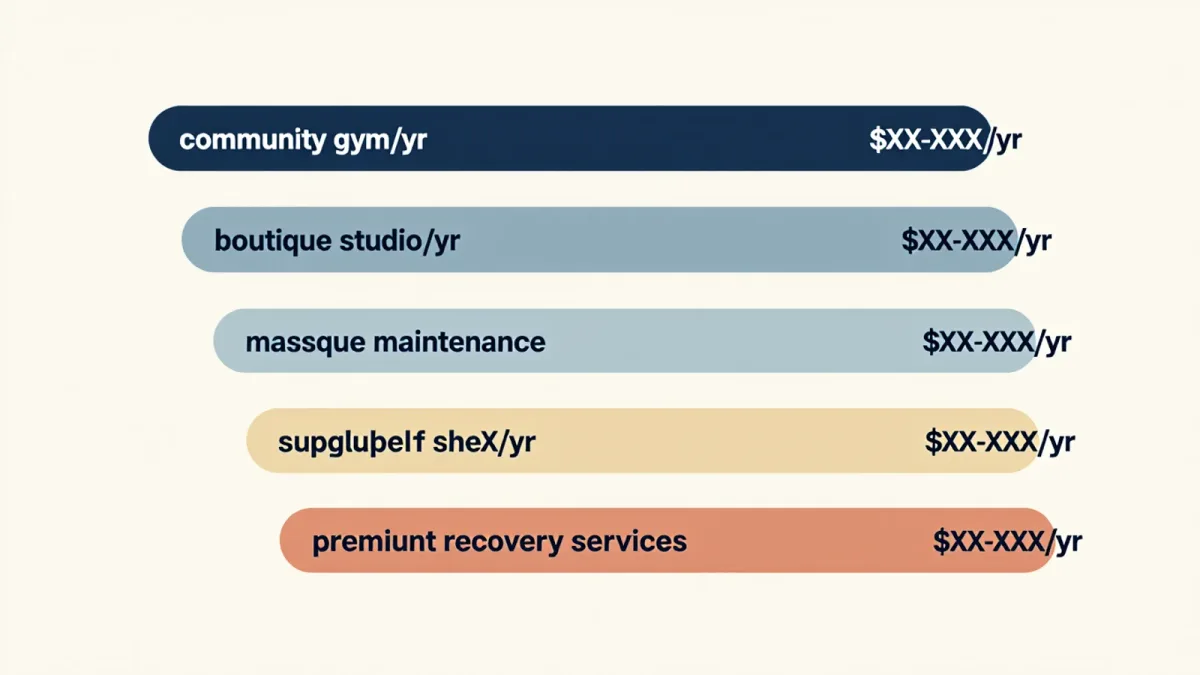
The categories, priced at representative 2026 levels drawn from published rates and market analyses:
| Category | Typical NYC 2026 price | Annualized (regular use) |
|---|---|---|
| Big-box gym membership | $30-110/month | $360-1,320 |
| Boutique fitness studio | $32-45/class, packs $2,000-4,000/yr | $2,000-4,000 |
| Massage, single session | $120-250 | $480-1,000 at quarterly |
| Med spa facial or injectables consult | $250-800 per visit | Highly variable |
| Supplements, monthly shelf | $40-120 | $480-1,440 |
| Wellness retreat weekend | $700-2,500 | Episodic |
The spread tells the real story: the same fitness outcome — three supervised sessions a week — costs $360 at a borough community gym or $4,000 at a branded studio whose conditioning science is, on published programming, largely the same. The wellness premium is the difference between the intervention and its packaging.
Is the wellness economy growing or correcting?
Growing, with an asterisk. The Global Wellness Institute's sector monitor put the global economy at $6.3 trillion in 2023 and projected continued growth toward roughly $9 trillion by 2028; New York, whose beauty and fitness sectors anchor the East Coast market, tracks the premium segments. Post-pandemic the growth concentrated in recovery, sleep, and longevity-adjacent services — the categories selling outcomes rather than sweat.
The asterisk is consumer strain. New York's own cost-of-living arithmetic — rent first, wellness fourth — makes discretionary subscriptions the natural casualty of a tight month, and studio chains' churn reflects it. The industry's response has been tiering: $15 community classes and $300 personal sessions now coexist within single brands.
Why is New York more expensive than elsewhere?
Three stacked multipliers, none of them mysterious. Commercial rent passes through to every studio class and treatment room; labor costs for certified trainers and licensed estheticians run above national averages; and the city's income distribution supports a premium tier that thinner markets cannot sustain. The result is a floor set by overhead and a ceiling set by appetite: national averages for a gym membership sit near $50 a month, while comparable Manhattan offerings commonly list at two or three times that, per published rate schedules. The services are not twice as effective; the square footage simply costs twice as much, and wellness is, commercially speaking, square footage with branding.
Does spending more buy better health outcomes?
Up to a modest threshold, then the curve flattens hard. The fundamentals with the strongest evidence — walking, resistance training twice weekly, sleep regularity, not smoking, social connection — cost little or nothing, a point federal guidance has made since physical-activity recommendations were first quantified in the 2008 federal guidelines. The paid tiers buy convenience, supervision, and ambiance: real value for people who need structure to show up, priced far above the marginal health gain they add.
The honest price curve of wellness in New York: the first few hundred dollars a year buys most of the documented health benefit; the next several thousand buys a nicer room in which to receive it.
Where is New York wellness money actually going?
Toward four growth pockets. Recovery services — saunas, cold plunges, compression-therapy lounges — expanded across Manhattan and Brooklyn through 2024 and 2025 at $35 to $75 a session. Longevity clinics sell executive physicals and biomarker panels at four figures per visit. Sleep retail — mattresses, trackers, cooling bedding — rides consumer-electronics economics. And the med-spa segment, blending cosmetic dermatology with wellness framing, remains the fastest-growth premium tier. None of these categories has outcome evidence proportional to its price; each sells a scarce New York commodity — time, attention, and the feeling of being looked after.
How do you build a sane New York wellness budget?
Anchor spending to the evidence tier, then buy pleasure knowingly. A defensible structure for a mid-income New Yorker: a $600-to-1,200 annual fitness base that will actually be used, a quarterly massage treated as legitimate maintenance, and a supplement shelf pruned to whatever a physician has actually confirmed a need for. Everything beyond that is hospitality — worth having, like restaurants, but accounted as pleasure rather than health. The discipline that matters is not frugality; it is refusing to let the hospitality line masquerade as the health line.
The bottom line
A full New York wellness year runs roughly $3,500 to $9,000 at 2026 prices, inside a global sector the Global Wellness Institute measured at $6.3 trillion in 2023 — but the documented health fundamentals cost hundreds, not thousands, and the premium buys convenience and care rather than additional years. Budget from the evidence upward, not from the brochure downward.